
OpenRouter Fusion: How It Works and When to Use It


OpenRouter Fusion in the Multi-Provider AI API Gateway Landscape
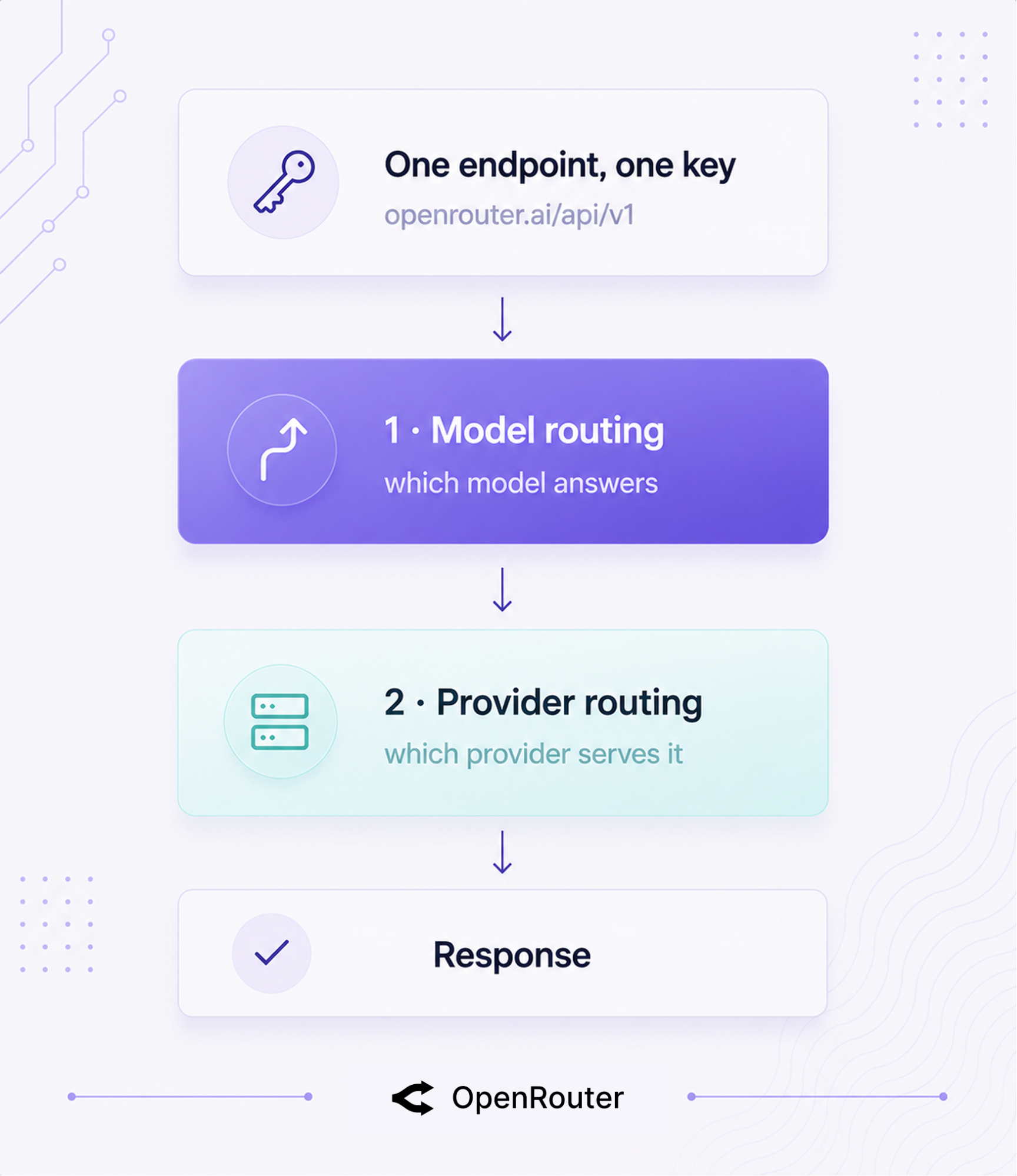
Every production AI feature eventually runs into the same uncomfortable truth: no single model provider is the best choice for every request, and no single provider is available one hundred percent of the time. OpenRouter Fusion lives in the layer that has grown up around that reality — the multi-provider AI API gateway, where traffic is normalized, routed, retried, and occasionally compared across models before a response ever reaches your application.
This is a technical deep dive into that layer. We will look at what OpenRouter Fusion actually is, how its routing machinery behaves under load, where fusion-style response selection helps, where it quietly inflates token spend, and how to judge it against alternatives such as CCAPI, a unified multimodal AI API gateway that offers transparent pricing and zero vendor lock-in.
A quick transparency note before we start: routing products evolve fast. Anything described here as a capability should be verified against OpenRouter's current documentation before you design around it.
What OpenRouter Fusion Is and What It Is Not

OpenRouter Fusion is best understood as a routing and response-selection feature layered on top of OpenRouter's model catalog. Where a plain gateway answers "which provider do I send this to?", a fusion layer also answers "should I send this to more than one model, and how do I pick between the answers?"
It is not a model. It is not a thin proxy either. A proxy forwards bytes; a fusion router makes decisions about cost, latency, availability, and quality before a single token is generated. And it is not a self-hosted inference stack — the compute still belongs to the underlying providers.
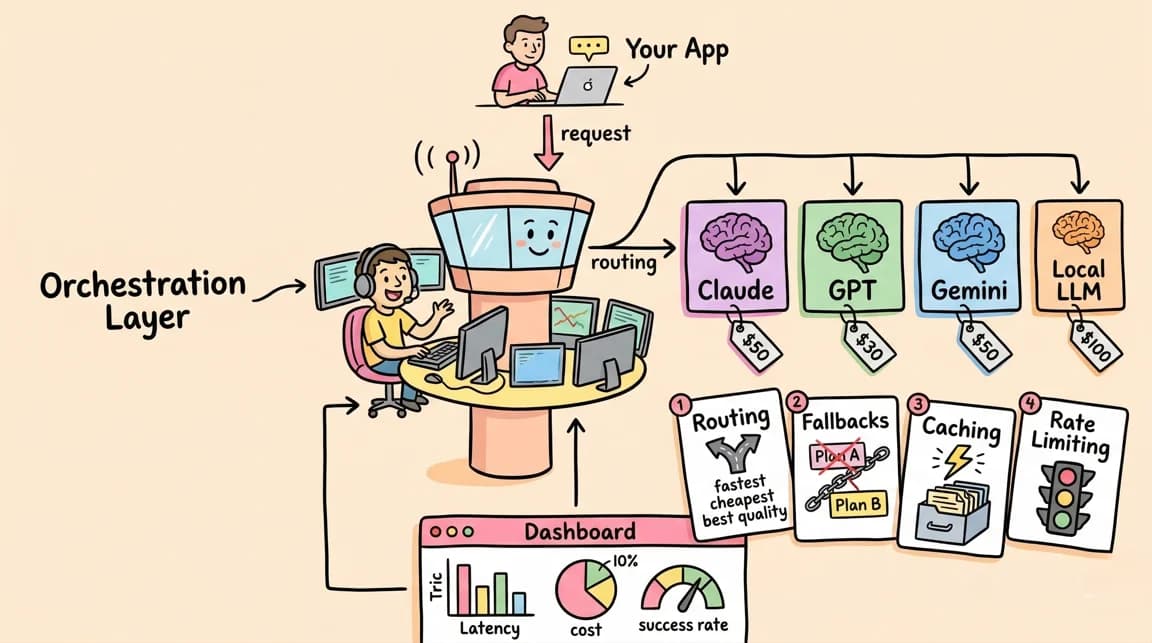
The distinction matters because teams frequently conflate three different products: direct provider APIs (one vendor, one contract, maximum control), pass-through gateways (one endpoint, many vendors, minimal logic), and orchestration gateways (one endpoint, many vendors, plus routing, fallbacks, and scoring). OpenRouter Fusion sits in the third bucket. So does CCAPI, though with a different emphasis: multimodal breadth across text, image, audio, and video rather than routing experimentation.
If you only need one model from one vendor, none of this layer is worth the abstraction.
Why Multi-Provider AI API Gateways Matter for Modern AI Apps
The pressure that created this category is real and measurable. Model sprawl means a typical product team now integrates three to six models within a year — a flagship reasoning model for hard tasks, a cheap model for classification, a vision model for screenshots, a speech model for voice. Provider outages happen, and a single-vendor dependency turns an upstream incident into your incident. Cost volatility is constant: per-token prices have dropped repeatedly and asymmetrically across vendors, so yesterday's cost-optimal route is often today's expensive one.
Then there is modality expansion. A team that started with chat completions now needs an image generation API, a video generation API, speech synthesis, and transcription — usually from different vendors with different auth schemes, different rate-limit semantics, and different file-upload flows. A unified AI API collapses that into one credential and one billing surface.
Here is the hidden insight most evaluations miss: routing layers reduce integration work but introduce dependency work. You gain a single endpoint, and you lose direct visibility into which provider served a request, why a fallback fired, and how much of your bill came from retries. Observability gaps, not routing bugs, are what usually bite teams six months in.
OpenRouter Integration Basics: Keys, Models, and Routing Policies
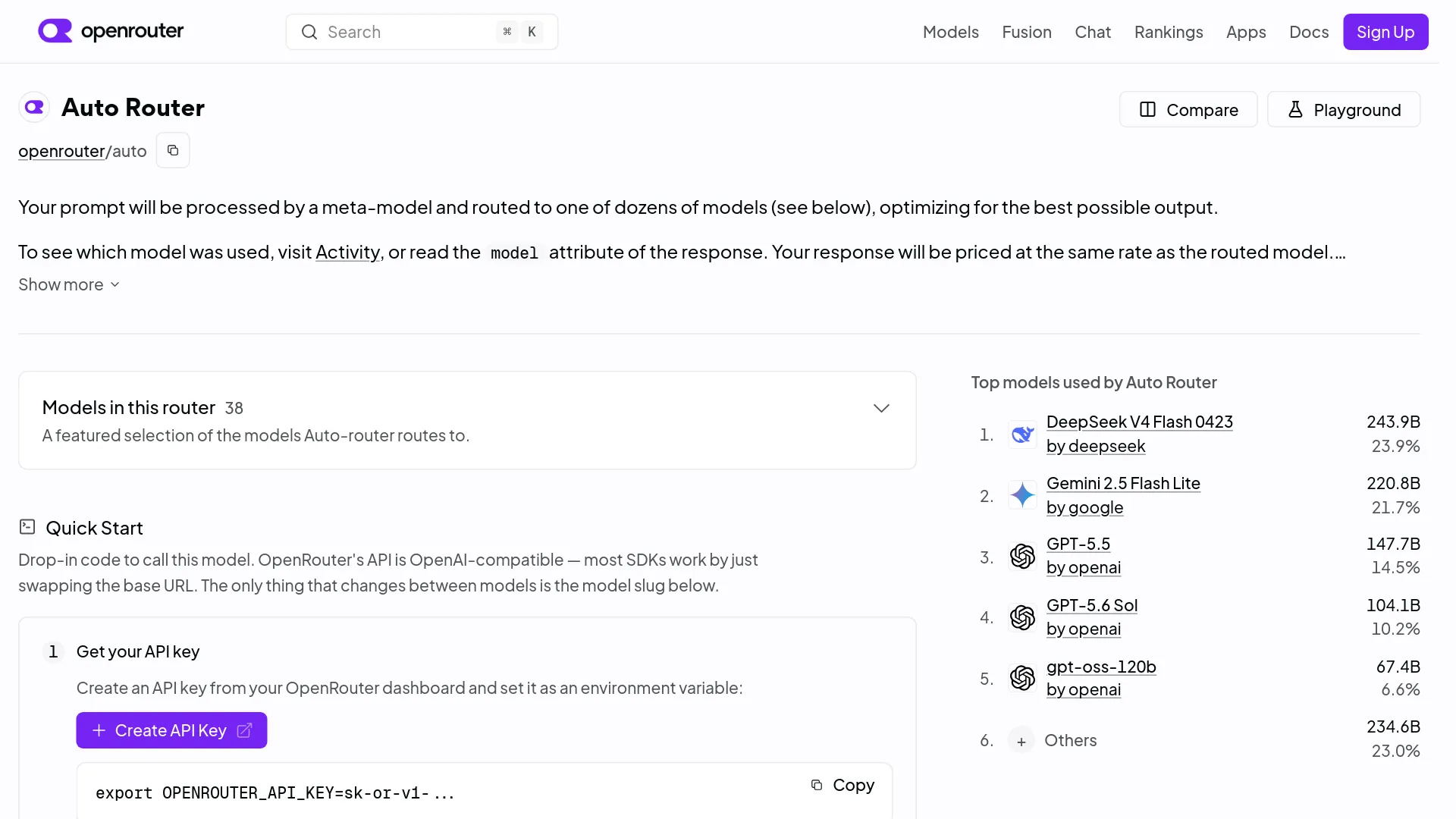
Getting started is deliberately low-friction. You create an API key, point an OpenAI-compatible client at the gateway's base URL, and pass a model identifier. Routing preferences are typically expressed either in the request body or through provider-level configuration — a fallback list, a provider ordering preference, a data-collection policy.
A minimal routing-shaped request looks roughly like this:
{
  "model": "anthropic/claude-sonnet-4",
  "messages": [{ "role": "user", "content": "Summarize this incident report." }],
  "models": ["anthropic/claude-sonnet-4", "openai/gpt-4.1", "google/gemini-2.5-pro"],
  "route": "fallback"
}
The models array is the important part: it is a declarative fallback chain rather than imperative retry code in your application. Streaming works over server-sent events, and usage is tracked per request. This baseline is what most teams run for months before they ever touch fusion-style features — and it is worth being deliberate about that sequencing. Routing reliability first, response quality optimization second.
How OpenRouter Fusion Handles AI Model Routing Under the Hood
Request Lifecycle: From API Call to Provider Selection
A request enters the gateway and is normalized: OpenAI-shaped payloads, Anthropic-shaped payloads, and provider-specific quirks are converted into a canonical internal form. The router then looks up the model in its catalog, checks provider availability and health, evaluates your routing policy against current pricing and latency signals, and dispatches. The response streams back through the gateway, which re-normalizes it and records token usage for billing.
Two details deserve attention. First, normalization is lossy in both directions — provider-specific parameters like reasoning budgets, cache controls, or tool-call dialects may not survive the round trip. Second, every hop adds latency: DNS, TLS, normalization, and (for streaming) buffering. That overhead is usually tens of milliseconds, but it is not zero, and it is the first thing to measure.
Routing Strategies: Cost, Latency, Quality, and Fallbacks
Most gateways expose some combination of four policy families:
| Policy | What it optimizes | Typical failure mode |
|---|---|---|
| Cost cap | Spend per request or per token | Quality drops silently on hard tasks |
| Latency target | Time-to-first-token | Over-routing to small, fast models |
| Quality scoring | Benchmark or judge-based ranking | Nondeterministic outputs |
| Fallback chain | Availability | Compounded latency and duplicate spend |
These interact badly when combined naively. A cost cap with an aggressive fallback chain can produce a request that burns three providers' worth of tokens while still landing on the cheapest model. A common mistake is enabling fallbacks without alerting on them — you then pay for two completions and never learn that your primary provider was degraded for a week.
Fusion Logic: Ensembling, Judge Models, and Response Selection
This is where the fusion concept earns its name. Rather than picking one model, a fusion policy can fan out a prompt to several models in parallel, then select a winner using a judge model, majority voting across semantically similar answers, or a quality-ranking heuristic. The fusion judge flow described in OpenRouter's materials follows exactly this shape: parallel panels, then adjudication.
Where this genuinely helps: open-ended generation, ambiguous classification, and any task where a single model's failure rate is the bottleneck rather than its ceiling. Where it hurts: deterministic pipelines. If you need byte-stable JSON, a judge-mediated selection process introduces nondeterminism you cannot easily test against. Treat fusion as a quality tool for human-reviewed output, not as a drop-in for structured extraction.
Billing, Rate Limits, and Provider Abstraction Details
Fusion multiplies token consumption by design — two panels plus a judge means roughly three times the tokens for one answer. That is a legitimate trade if quality gain outweighs cost, but it must be measured per task, not assumed.
Rate limits are inherited, not pooled in most cases: you are still constrained by the underlying provider's limits, and a burst that fans out to three providers can trip three different throttles simultaneously. Provider-specific quirks — safety filters, context-window edge cases, tool-call formatting — are smoothed over by abstraction, which is convenient until you need to debug why one provider refuses a prompt that another accepts. This is the core argument for gateways with transparent pricing and no routing-specific lock-in, which is where CCAPI positions itself: same model access, fewer proprietary abstractions to unwind later.
OpenRouter Fusion Capabilities, Pros, and Cons
Supported Modalities and Provider Coverage
Text coverage is broad and mature. Image and audio coverage varies meaningfully by gateway. Video — particularly text to video workflows — is the least standardized surface, since generation times are long, outputs are large, and pricing is often per-second rather than per-token. If your roadmap includes an image generation API, a video generation API, or a text to video pipeline, verify modality coverage before you commit, because "supports 300 models" rarely means "supports 300 models across every modality."
Performance Benchmarks: Latency, Throughput, and Cost Trade-offs
Benchmark four numbers, not one:
- Routing overhead — gateway time excluding provider time
- Time-to-first-token — what users actually feel in streaming UIs
- Streaming stability — mid-stream disconnects under sustained load
- Cost per successful task — including retries and fusion fan-out
The last one is the number that surprises teams. Fusion can improve answer quality by a meaningful margin and still double cost per successful task. That may be a great trade for a revenue-generating agent and a terrible one for a nightly batch job.
Pros and Cons of OpenRouter Fusion
Pros: fast access to many providers, declarative fallbacks, cheap model experimentation, consolidated billing, and the ability to A/B a new model in an afternoon rather than a sprint.
Cons: reduced transparency into routing decisions, latency variance under fallback, lock-in through routing-specific configuration, debugging complexity across three systems you do not control, and unclear cost attribution per feature.
Security, Privacy, and Compliance Considerations
Multi-provider routing means multi-provider data exposure. Prompt and output retention policies differ per vendor; some train on API data by default unless disabled, and some route through regions your legal team may not have approved. A gateway that supports a data-collection policy flag is not the same as a gateway that guarantees zero retention.
For regulated workloads, document three things explicitly: which providers are permitted, what retention terms apply to each, and how you prove that a given request went to a permitted provider. If you cannot produce logs that answer the third question, you do not have a compliant routing setup regardless of what the dashboard says.
When to Use OpenRouter Fusion: High-Value Use Cases
Best-Fit Scenarios for AI Model Routing
The clearest wins are multi-model chatbots where different intents deserve different models, high-availability assistants where a single provider outage is unacceptable, cost-sensitive batch workloads where you can trade quality for price during off-peak windows, and any system with a hard availability SLO.
Multimodal Workflows: Text, Image, Audio, and Video Generation
Fusion-style routing is far less useful here than plain unified access. What multimodal pipelines need is one credential and one billing surface across an image generation API, a video generation API, and speech models — not judge-based selection between two image models at three times the price. This is the gap CCAPI was built for, spanning text, image, audio, and video generation across OpenAI, Anthropic, Google, and others through one gateway with published pricing.
Rapid Prototyping, A/B Testing, and Model Evaluation
Routing makes model comparison almost free: change a model identifier, shadow a percentage of traffic, compare. The hidden trap is that without a fixed evaluation set, routing experiments optimize for novelty instead of business outcomes. Teams end up shipping whichever model was newest during the experiment window.
When OpenRouter Fusion Is Overkill
Skip it when you have a strict latency budget (fusion fan-out is incompatible with sub-second first-token targets), a narrow model need, predictable per-request costs, or compliance requirements that mandate a single named provider. A direct provider integration is boring, and boring is often correct.
OpenRouter Fusion Alternative Comparison: Multi-Provider AI API Gateways
Evaluation Criteria
Score candidates on: supported models per modality, routing rule expressiveness, fallback semantics, observability hooks, pricing transparency, rate-limit behavior, SLA coverage, and — most overlooked — exit path. How hard is it to leave in eighteen months?
CCAPI as an OpenRouter Fusion Alternative
CCAPI is a unified multimodal AI API gateway offering access to major models from OpenAI, Anthropic, Google, and others for text, image, audio, and video generation. The pitch is straightforward: transparent pricing, no vendor lock-in, and a single endpoint across modalities. Explore the full model catalog before evaluating; for teams that need faster or specialized models, it also carries options like the DeepSeek API, Qwen API, Kimi API, and MiniMax API alongside image and video generation families such as Seedream and Seedance. If routing control is your priority, OpenRouter Fusion is the more feature-rich choice. If multimodal breadth and pricing clarity are your priorities, the calculus changes.
Other Alternative Patterns
Direct provider integrations maximize control and minimize abstraction, at the cost of duplicated auth, retries, and billing plumbing per vendor. Self-hosted routers give you full observability and zero markup, but you own uptime, upgrades, and provider drift. Custom internal gateways are the right answer above a certain scale — usually when you already have a platform team and a mature observability stack.
Feature Matrix
| Criterion | OpenRouter Fusion | CCAPI | Direct Integrations |
|---|---|---|---|
| Routing flexibility | High (policies, fallbacks, fusion) | Moderate–high | None (app-level) |
| Modality coverage | Broad for text, variable elsewhere | Text, image, audio, video | Per vendor |
| Pricing visibility | Good, markup embedded | Transparent, see pricing | Lowest cost, highest overhead |
| Lock-in risk | Routing-specific config | Low, vendor-neutral | Low |
| Setup speed | Minutes | Minutes | Hours to days per vendor |
| Observability | Gateway-level | Gateway-level plus token usage | Full but fragmented |
OpenRouter Integration and Migration Patterns
Integration Patterns
Most integrations use an OpenAI-compatible REST surface, with SDKs wrapping it, server-sent events for streaming, async jobs for long-running media generation, and webhooks for usage events. The abstraction cost is real: routing-specific fields like fallback arrays and provider preferences do not exist elsewhere, so they must be re-expressed as explicit application logic during a migration.
Migrating to a Unified AI API
The sequence that works: inventory every model in use, map each to an equivalent endpoint, port prompts and re-run your golden set, replicate fallbacks as configuration, then canary. Use an MCP server if your workflow is agent-driven — it lets coding assistants and orchestration tools call the gateway directly without bespoke glue. Testing before cutover is the difference between a one-week migration and a one-quarter one.
Architecture Checklist and Testing
Ensure retry logic is bounded, circuit breakers are per-provider rather than global, requests are idempotent where possible, prompts are versioned, model names are aliased so swapping is a config change, secrets live in a manager, and traces flow to your existing backend — OpenTelemetry is a reasonable standard to target.
Real-World Implementation: Lessons from Production
Case Study: Fallbacks in a Support Chatbot
A support bot ran on a single frontier model. During a regional provider degradation, first-token latency tripled and the bot started hallucinating escalation intents. Adding a fallback chain fixed availability but introduced a tone mismatch — the secondary model was terser, and CSAT dipped on fallback-served conversations. The fix was prompt adaptation per model plus tagging fallback responses for QA review. Fallbacks solve availability, not consistency.
Case Study: Multimodal Content Pipeline
A marketing pipeline generated copy, hero images, narration, and short video clips. Four vendors meant four SDKs, four billing relationships, and four failure modes. Consolidating on one gateway across an image generation API, a video generation API, and speech cut integration surface dramatically — and made provider swaps a config change rather than a refactor.
Common Pitfalls and Lessons
The recurring failure modes are consistent: duplicated tokens from unnoticed fallbacks, JSON schema drift between models, rate-limit collisions when fan-out hits the same upstream, silent provider deprecations, and cost attribution that nobody owns. Routing without observability is the worst of both worlds — you pay for redundancy and lose the reliability you thought you bought.
Advanced Techniques for AI Model Routing and Cost Optimization
The mature pattern is cost-aware routing with feedback loops. Classify requests by difficulty (a cheap model can do this), route easy traffic to inexpensive models, reserve expensive models for the hard tail, and continuously recalibrate based on measured quality per segment. Add per-model dashboards, budget alerts at the feature level, and prompt-version tracking so a quality regression is attributable to a prompt change rather than a mystery.
Finally, keep an exit rehearsed. Periodically route a small percentage of traffic through a second gateway — for example a CCAPI alternative path on your non-critical jobs. If that path has never carried traffic, it is not a fallback; it is a hypothesis.
Conclusion
OpenRouter Fusion is a genuinely useful layer for teams that need multi-provider resilience and are willing to accept some abstraction cost in exchange. It is strongest where quality and availability matter more than determinism, and weakest where you need byte-stable output at a fixed price.
The decision comes down to what you value: routing sophistication, or multimodal breadth with transparent pricing and no lock-in. Evaluate both against a golden dataset, not a feature list — and settle your usage and billing model before you scale, because that is where the surprises live.