
Image Generation Models Compared: Cost, Edit, Quality
Image Generation Model Comparison in the Multimodal Era: Cost, Editing, and Quality
An image generation model comparison used to be a weekend experiment: pick two models, run the same prompt, and argue about which picture looks nicer. That approach breaks down the moment image models become part of a product. When images are generated inside a checkout flow, an ad pipeline, or a game asset tool, the questions change. Does the model follow object counts reliably? Can it edit an existing product photo without warping the logo? What does a usable image actually cost after retries, moderation, and human review?
This deep dive builds a technical framework for evaluating image generation models across cost, editing fidelity, quality, latency, and governance — with the implementation details that separate a benchmark from a production decision. Along the way, we'll look at how a unified image generation API changes the economics of running that comparison at scale.
1. Why Image Generation Model Comparison Is Different in the Multimodal Era
Historically, image generation lived in isolated tools. You opened a web UI, typed a prompt, downloaded a PNG, and moved on. Benchmarks were aesthetic. Today, image models sit next to language models, speech models, and video models inside the same application, often behind one authentication layer and one billing account. That shift makes comparison an engineering problem rather than a taste problem.
From Single-Model Tests to Unified Image Generation API Workflows
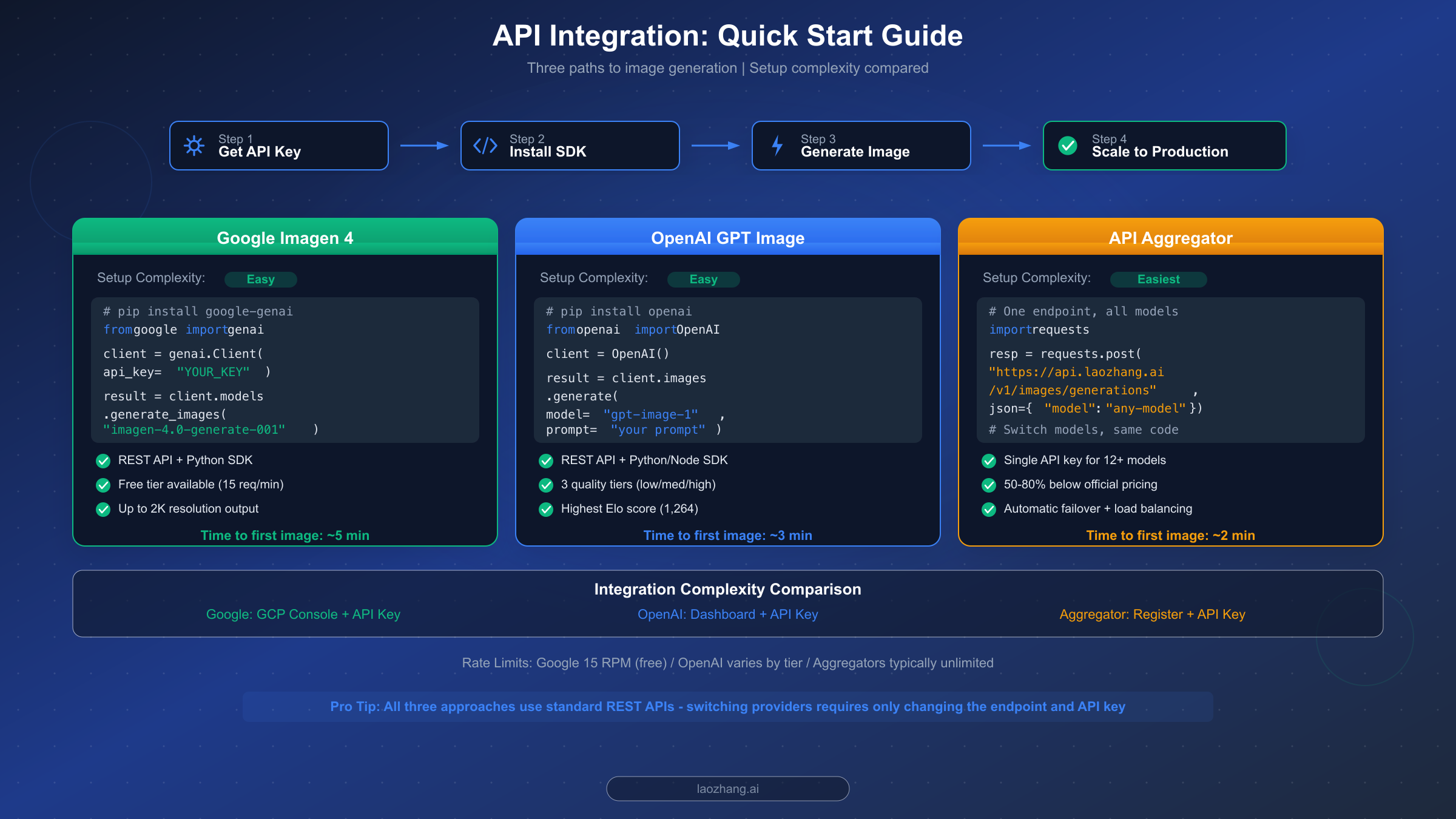
A unified interface lets you send the same prompt, seed, resolution, and reference image to several providers and store the results in one place. That sounds trivial, but it removes the biggest source of noise in manual comparisons: inconsistent parameters. Different providers expose different defaults, so a "fair" test requires normalizing guidance scale, steps, aspect ratio, and safety settings before you compare anything.
The hidden dimension most teams miss is routing and failure recovery. A production evaluation should measure not just the best output from each model, but how the system behaves when a provider times out, throttles, or returns a moderation rejection. A comparison that ignores fallback behavior will look great in a notebook and fail at 3 a.m.
Core Criteria: Cost, Editing, Quality, Latency, and Governance
Throughout this article, we'll score models on seven dimensions: per-accepted-asset cost, edit fidelity, prompt adherence, p50/p95 latency, safety and moderation behavior, licensing and commercial rights, and observability. Weighting depends on your use case — a game studio cares more about style consistency; a performance marketing team cares more about text rendering and turnaround time.
How CCAPI Fits into Modern Model Evaluation
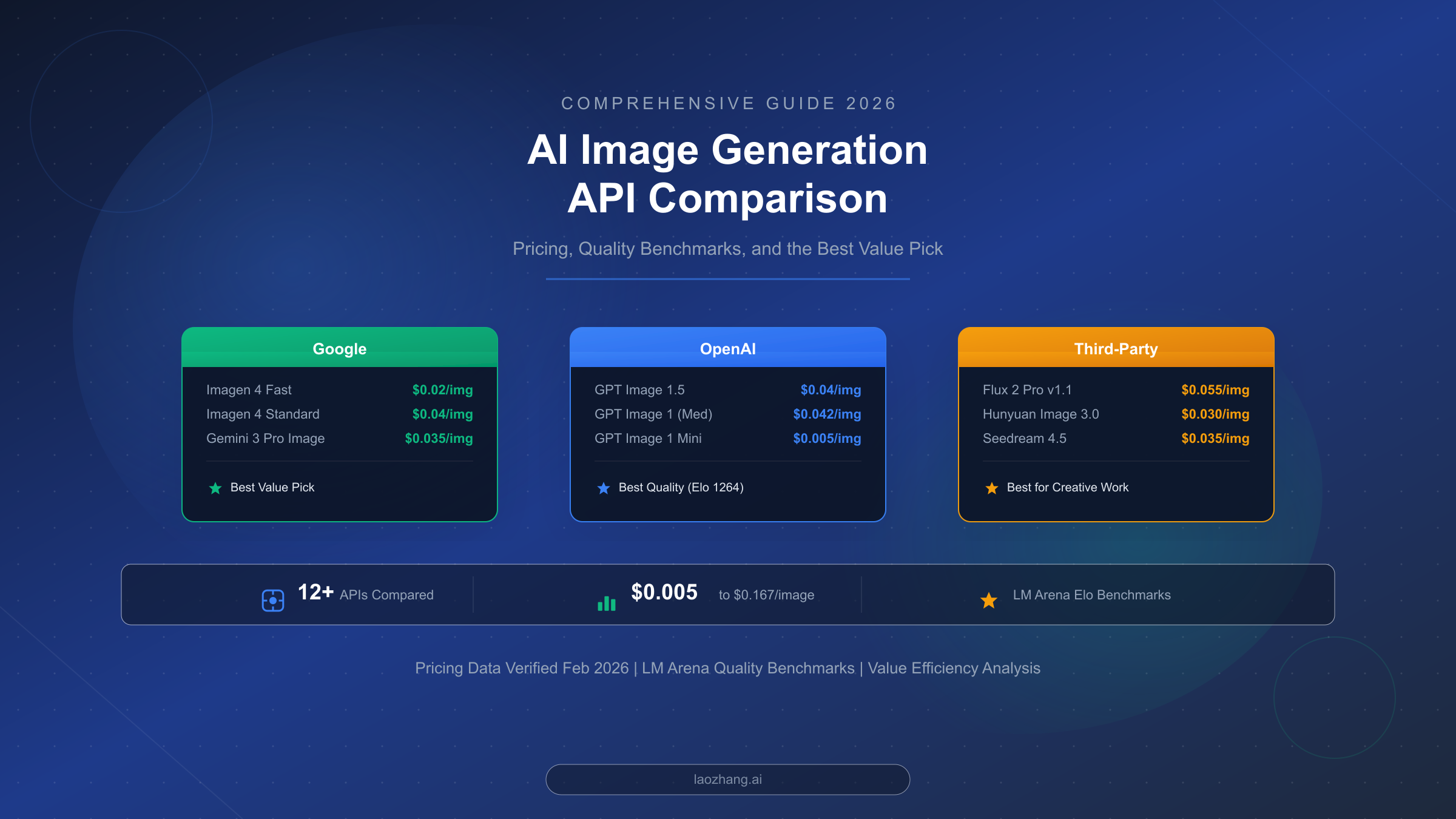
CCAPI is a unified multimodal AI API gateway that exposes text, image, audio, and video models through one contract, with transparent pricing and no vendor lock-in. For evaluation work, that matters in a concrete way: you can swap model values instead of rewriting SDK calls, and you can compare spend across providers from one ledger rather than reconciling four invoices.
2. How Image Generation Models Work Under the Hood
You cannot interpret benchmark differences without a rough mental model of the architecture. Two models can produce similar-looking images while consuming wildly different compute.
Diffusion, Transformer, and Hybrid Architectures
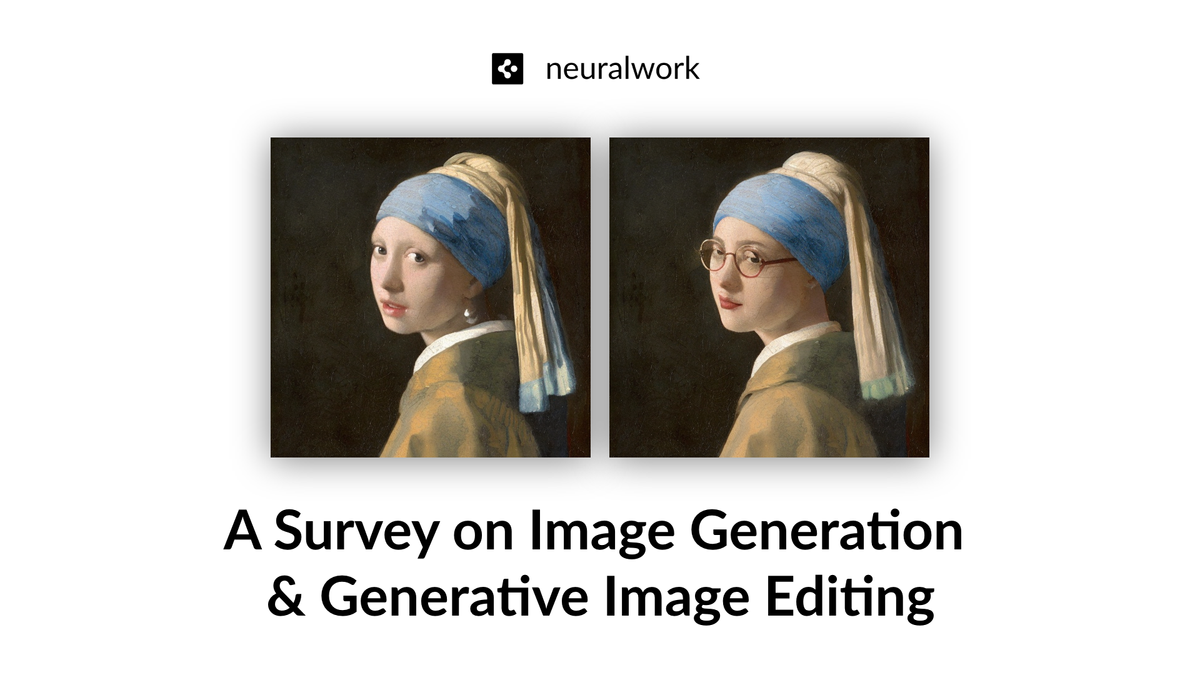
Latent diffusion models denoise in a compressed latent space, which is why they scale reasonably with resolution. Transformer-based diffusion backbones — the "DiT" family behind several modern open-weight models — replace the U-Net with attention blocks and tend to reward larger training compute. Autoregressive image models tokenize images and generate them like text, which gives them strong language grounding and surprisingly good in-image typography, but usually at higher cost per image. Hybrid systems route different stages to different architectures, for example a transformer for layout and a diffusion decoder for texture.
Why Architecture Affects Image Model Cost Comparison
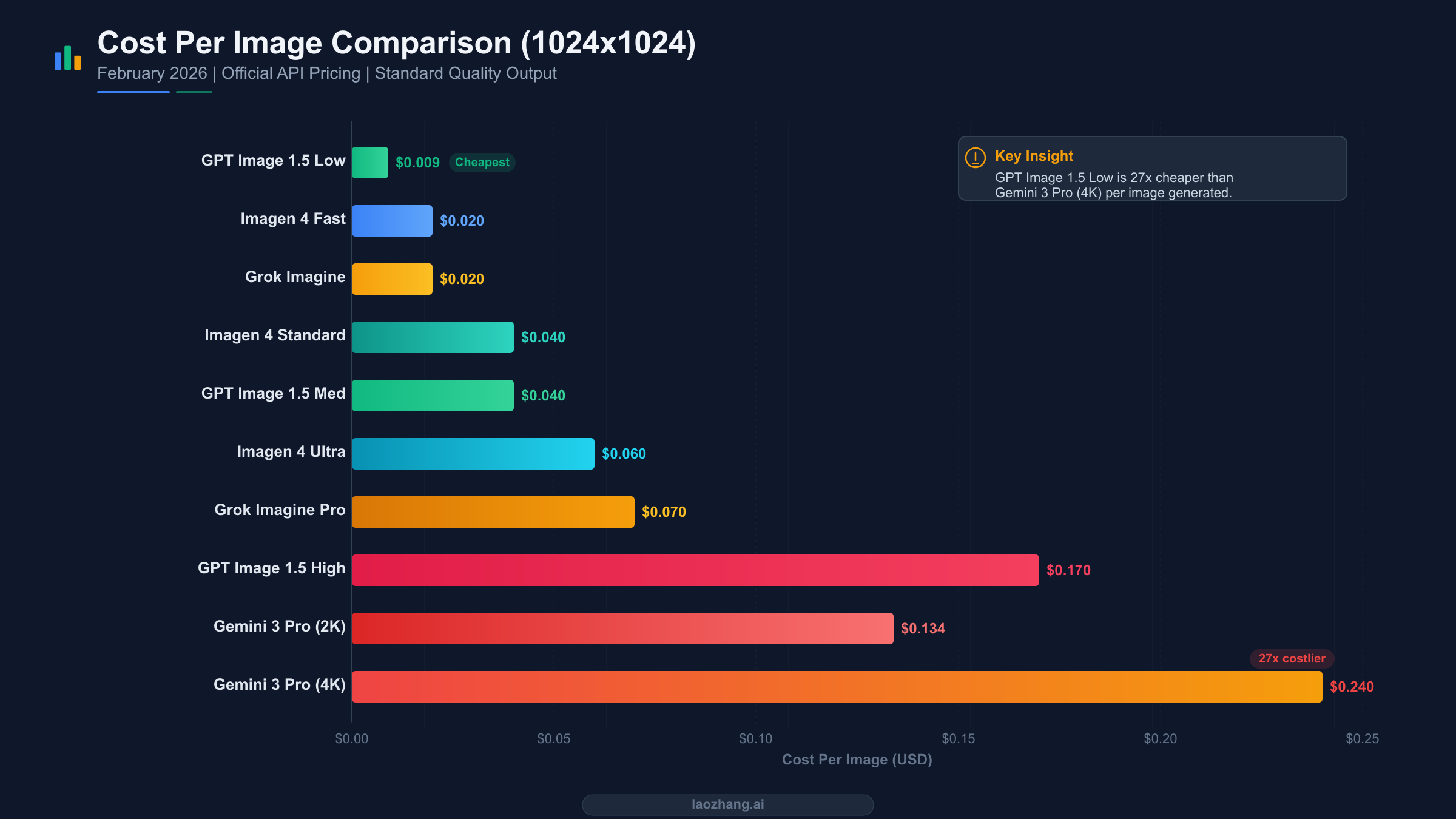
Cost per image is a misleading metric. What matters is cost per accepted asset. A cheap model that requires four retries is more expensive than a premium model that lands in one. Architecture influences this through sampling steps, resolution scaling behavior, and batching efficiency — a model that doubles GPU time past 1024px will destroy your margin if your catalog needs 2048px hero shots.
API Parameters That Change Output Quality and Editing Control
Guidance scale (classifier-free guidance), step count, seed, aspect ratio, negative prompts, image references, and masks all shift results. Small changes create large variance:
import os, requests

GATEWAY = os.environ["AI_GATEWAY_URL"]  # provided by your gateway

payload = {
    "model": "provider/image-model",
    "prompt": "matte ceramic mug on oak table, soft window light",
    "size": "1024x1024",
    "steps": 30,
    "guidance_scale": 6.5,
    "seed": 42,
    "negative_prompt": "text, watermark, extra handles",
    "reference_image": "https://cdn.example.com/mug-base.png",
    "mask": "https://cdn.example.com/mug-mask.png",
    "fallback_models": ["provider-b/image-model", "provider-c/image-model"],
}

resp = requests.post(f"{GATEWAY}/v1/images/generations", json=payload, timeout=120)
resp.raise_for_status()
asset = resp.json()
If your benchmark fixes seeds but not guidance scale, you are comparing provider defaults, not models.
Advanced Techniques: Regional Prompts, ControlNets, and Reference Conditioning
Spatial control is where expert users separate from casual ones. ControlNet-style conditioning (pose, depth, canny edges), IP-Adapter-like style references, regional prompts, and identity-preservation adapters determine whether a model can be used for product photography or character work. CCAPI can abstract provider-specific parameter names where an equivalent exists, which keeps your evaluation harness stable across providers.
3. Cost Analysis: Building a Realistic Image Model Cost Comparison
Sticker price is the least interesting number in this article. Total cost of ownership is what shows up on the invoice.
Pricing Units: Per Image, Per Megapixel, Per Token, and Subscription
| Pricing unit | Typical driver | Risk |
|---|---|---|
| Per image | Flat rate per render | Penalizes high-resolution work |
| Per megapixel | Output dimensions | Cost scales with 4K assets |
| Per token / unit of compute | Model internals | Hard to forecast without telemetry |
| Subscription / seat | Monthly quota | Unused capacity wasted, overage fees |
Normalize everything to cost per accepted asset at your target resolution before comparing.
Hidden Costs: Retries, Storage, Moderation, Upscaling, and Egress
The costs that surprise teams are the ones that appear after generation: moderation passes that add latency and sometimes a second API call, image upscale steps for print or retina delivery, object storage and CDN egress, and human review time for anything customer-facing. A model with a 60% first-pass acceptance rate quietly costs 1.6x its listed price.
Batch vs Real-Time Generation Economics
Asynchronous batch endpoints — the kind offered with roughly 50% discounts and 24-hour turnaround windows by several major providers — are ideal for catalog backfills and storyboard drafts. Real-time calls are for interactive editing and user-triggered generation. The correct architecture usually runs both against the same routing layer.
How CCAPI's Transparent Pricing Reduces Cost Uncertainty
CCAPI's transparent pricing removes the spreadsheet archaeology of mapping provider-specific units into a common denominator. Because billing is consolidated, you can attribute spend per feature, per team, or per model without building a custom ETL job. Start from the pricing page when you model unit economics.
4. Editing Capabilities in an Image Generation Model Comparison
Editing deserves its own scorecard. Plenty of models generate beautifully and edit poorly, especially across multiple iterations where artifacts compound.
Inpainting, Outpainting, and Mask-Based Edits
Mask fidelity is measurable: how cleanly does the model blend at mask edges, how much surrounding context does it preserve, and does it hallucinate outside the masked region? Some APIs accept soft masks with feathering; others accept binary masks only. Outpainting adds a second failure mode — scene extension that drifts in lighting or perspective.
Instruction-Based Editing and Reference Image Support
Instruction-based editing ("remove the shadow, change the shirt to teal") is now the competitive frontier, with Gemini's image editing models and OpenAI's GPT Image line among the strongest at preserving identity across edits. The hidden insight: editing quality correlates more with reference handling than with base model aesthetics. A model that ingests a clean reference image and respects it will beat a more "beautiful" model that ignores conditioning.
Consistency Across Iterations: Characters, Products, and Styles
For e-commerce, advertising, and game asset pipelines, consistency is the product. Measure it by generating the same subject across ten prompts and computing embedding similarity between outputs — or, more practically, by having a reviewer tag drift.
How to Benchmark Edit Quality with Reproducible Tests
Use a fixed protocol: 20 source images, standardized masks, five prompt variants per image, and blind scoring on edit accuracy, artifacts, and unintended changes. Store the seed and parameters with every output so the test is reproducible six months later when a provider silently updates its model.
5. Quality Benchmarks: Photorealism, Prompt Adherence, and Typography
"Best quality" is not a measurable claim. Split it into components.
Prompt Adherence and Semantic Fidelity
Adherence covers object counts, spatial relations, colors, and negations. Benchmarks such as T2I-CompBench and GenEval are useful proxies, but for commercial work a small internal test set of your own hardest prompts beats any public leaderboard.
Aesthetic Quality, Artifacts, and Resolution
Aesthetics cover lighting, anatomy, and texture. Artifacts — extra fingers, melted text, inconsistent shadows — destroy usability faster than a slightly flat composition. Resolution interacts with all of it: many models degrade subtly above their native training resolution, and that degradation is where image upscale steps become necessary.
Text Rendering, Logos, and Typography
Typography remains the sharpest differentiator for marketing and packaging. Autoregressive and hybrid models generally render short strings better than pure diffusion, and almost every model distorts brand logos. If your workflow requires legible text at small sizes, test it explicitly rather than assuming.
Human Evaluation vs Automated Metrics
FID and CLIP-style scores measure distribution similarity and prompt alignment; human preference models approximate aesthetics. None of them capture brand safety, licensing risk, or whether a retoucher can fix the output in five minutes. Run automated metrics for screening and human panels for decisions.
Real-World Examples from Production Workflows
An e-commerce team I worked with measured that only 40% of generations passed their product-accuracy check — but 78% passed after adding a reference-image conditioning step. A social ads team found typography failures caused more rework than composition problems. A newsroom-style editorial pipeline cared almost entirely about licensing and reproducible seeds. CCAPI makes those side-by-side tests cheap enough to run continuously rather than quarterly.
6. Side-by-Side Model Landscape: Proprietary, Open-Source, and Multimodal AI API Options
The landscape splits usefully into three camps rather than a single ranking.
OpenAI, Google, and Anthropic in Multimodal Workflows
OpenAI and Google both ship image generation and editing inside broader multimodal platforms, which is convenient when your pipeline also needs text reasoning or audio. Anthropic's strength is text and code, so it typically appears in the orchestration layer rather than as the image renderer.
Stability AI, Ideogram, Black Forest Labs, and Open-Source Variants
Open-weight families (Stable Diffusion derivatives, FLUX, and Qwen's image models) give you fine-tuning and self-hosting control, at the cost of GPU operations, cold starts, and upgrade maintenance. Ideogram and similar platforms lean into typography and design use cases. Midjourney's API access and hosted-only models round out the premium aesthetic segment.
When a Unified Image Generation API Beats Direct Integrations
If you are testing five providers, direct integrations mean five auth schemes, five payload shapes, and five billing relationships. A gateway such as CCAPI collapses that into one contract, one token ledger, and one fallback chain — a genuine openrouter alternative for teams that need multimodal coverage beyond text.
7. API Integration: Choosing an AI Image Generation API
Integration cost is real cost. This section is about the developer experience that determines whether your comparison survives contact with production.
Authentication, Endpoints, Payloads, and Response Formats
API keys are the norm; OAuth appears in enterprise deployments. The painful part is payload divergence — one provider returns base64, another returns a signed URL that expires in an hour, another streams partial results. Normalizing response handling is where integration hours disappear.
Rate Limits, Concurrency, Retries, and Fallbacks
Design for idempotency keys, exponential backoff with jitter, and a provider fallback chain. Rate limits are usually per-minute request caps and concurrent-job caps, so throughput is bounded by the smaller of the two.
SDKs, Observability, and Cost Tracking
Log the model, parameters, latency, token or image count, and acceptance status for every call. Without that telemetry, a model comparison becomes anecdote within a month. Gateways typically expose a usage dashboard and token management; you can inspect your own allowances in the token console and top up via the billing page.
Pros and Cons of Unified Image Generation API vs Direct Integrations
| Dimension | Unified gateway | Direct integrations |
|---|---|---|
| Integration effort | One contract, many models | Per-provider work |
| Pricing visibility | Consolidated | Fragmented |
| Latency overhead | Small added hop | Lowest possible |
| Provider-specific features | Best-effort abstraction | Full access |
| Fallback routing | Built in | You build it |
Zero Vendor Lock-In with CCAPI
CCAPI's zero vendor lock-in model means swapping from one provider's image model to another is a configuration change, not a migration. That matters when a provider raises prices, deprecates a model, or changes its safety policy overnight.
8. Multimodal Workflows: Beyond Still Images
Images rarely ship alone. A marketing asset might start as text, become an image, animate into text to video, and gain a voiceover — all through one multimodal AI API.
Combining Text, Image, Audio, and Video Generation
Orchestration patterns matter more than individual model quality here. Chain steps with explicit contracts: text → prompt refinement → image → upscale → video → audio. Each hop should record its inputs so a failure can be replayed.
Image-to-Image, Text-to-Video, and Storyboarding Pipelines
Storyboarding is the clearest example: generate a keyframe grid, let a human approve composition, then feed approved frames into a video model with motion prompts. Provider choice for the video stage should not force a rewrite of the image stage.
Orchestration Patterns with a Multimodal AI API
Routing, caching, human-in-the-loop review, and per-step cost budgets are the four patterns that keep multimodal pipelines economical. CCAPI's multimodal surface lets you express these as configuration rather than bespoke glue code.
9. Performance, Reliability, and Production Readiness
Capability without dependability is a demo.
Latency, Throughput, and Cold Starts
Synchronous generation typically lands between a few seconds and half a minute depending on steps and resolution. p95 latency, not p50, determines perceived reliability. Self-hosted open-weight models add cold-start penalties when servers scale to zero.
Failure Modes and Graceful Degradation
Plan for moderation rejections, timeouts, and provider outages. A degraded mode that returns a lower-resolution image is better than a spinner.
MCP and Agent-Driven Tooling
If your team uses agentic coding tools, exposing image generation as an MCP server lets agents request assets directly. CCAPI's MCP endpoint at the MCP integration page is worth reviewing if you want generation inside developer workflows rather than a separate dashboard.
10. Security, Compliance, and Governance
Governance questions decide enterprise adoption. Ask who owns the output, what the training-data posture is, and whether the provider indemnifies commercial use. Synthetic-content disclosure is becoming a regulatory expectation in several jurisdictions, and C2PA-style content credentials are increasingly available. Store provenance metadata alongside every asset.
11. A Repeatable Evaluation Framework
Turn the scorecard into a habit: a 30-prompt golden set, fixed parameters, weekly runs, automated adherence screening, and quarterly human panels. Re-run after every provider model update — silent updates are the most common cause of benchmark drift.
12. Conclusion: Building a Durable Image Generation Stack
A credible image generation model comparison is really a measurement system: normalized parameters, per-accepted-asset cost, edit-fidelity tests, adherence scoring, and telemetry that survives model updates. Run it through a unified image generation API and you get one integration, one bill, and the freedom to move when a better model — or a cheaper one — arrives. That is the practical case for CCAPI: transparent pricing, model choice across providers, and zero vendor lock-in, so your architecture outlives your current favorite model.