
Gemini 4 Argon: Built to solve your hardest problems


Gemini 4 Argon API: A Deep Dive into Multimodal Workloads, Gateways, and Production Readiness
When Google signaled that its next-generation Gemini model—internally dubbed Gemini 4 Argon—would target what it calls the "hardest problems," developers and platform teams took notice. The Gemini 4 Argon API is being positioned as a serious candidate for complex reasoning, long-context analysis, and multimodal workloads that historically required stitching together multiple specialized models. In this deep dive, we'll go past the headline claims, examine what developers actually need to verify before production adoption, and look at how a unified multimodal AI API gateway like CCAPI fits into the picture.
This article is informational and technical in nature. Where the news coverage stops at marketing, we'll go deeper into integration checklists, evaluation harnesses, gateway trade-offs, and the operational realities that decide whether a model succeeds in production.
Gemini 4 Argon API: Core Announcement and Positioning

The initial coverage frames Gemini 4 Argon as Google's answer to the growing demand for models that can handle workloads where smaller or cheaper models quietly fail. The phrase "hardest problems" is not incidental—it signals targeting of multi-step reasoning, code synthesis across large repositories, scientific and financial research synthesis, and multimodal understanding across text, image, audio, and video.
What the Announcement Claims—and What Remains Unconfirmed
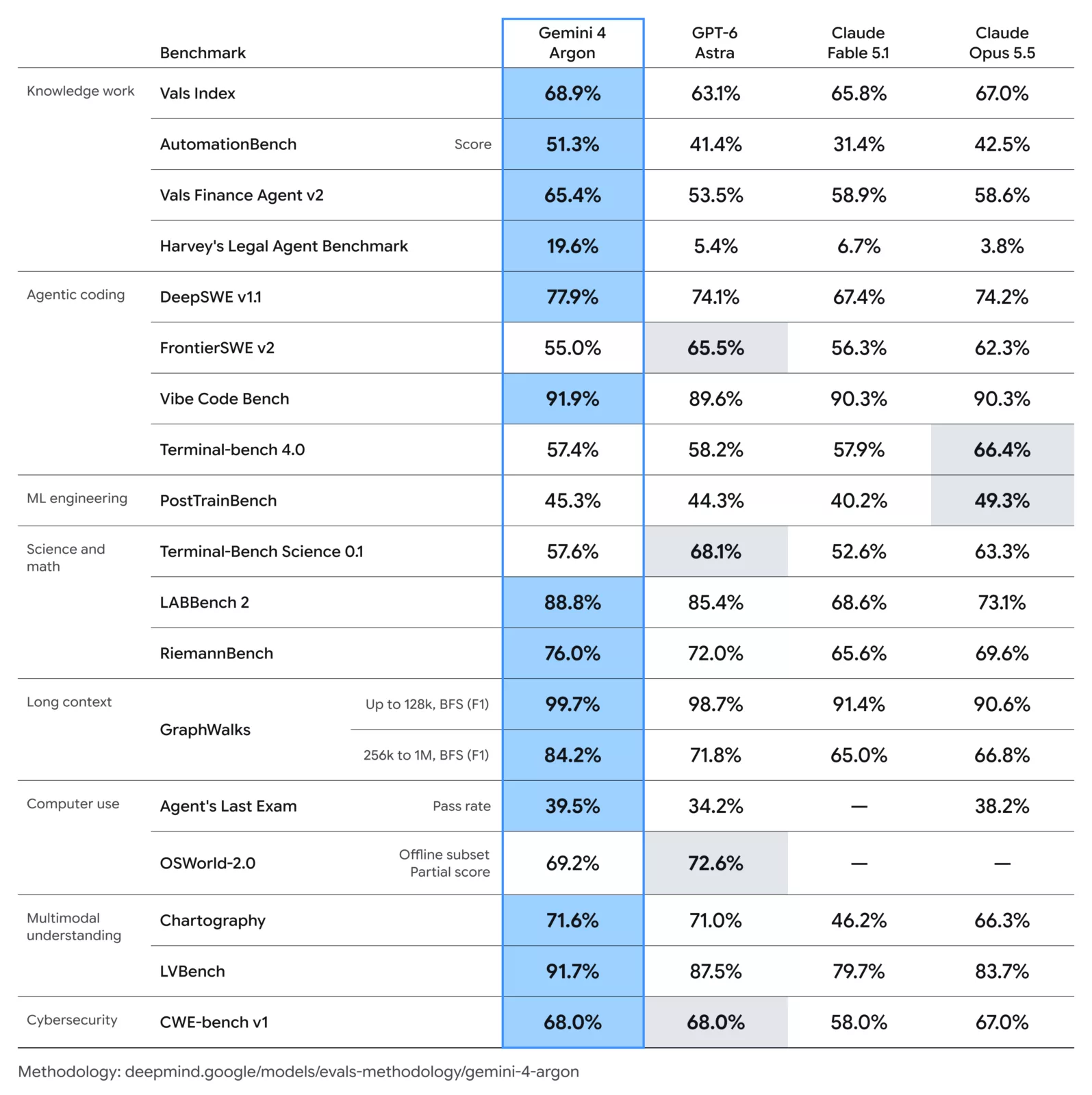
At announcement time, teams are typically given high-level claims: expanded context windows, improved tool-calling reliability, and stronger multimodal grounding. What is not usually provided, and what must be confirmed through official documentation, includes exact token limits, latency SLAs, regional availability, quota tiers, and pricing structure. Treat any speculative benchmark numbers you see in early coverage as provisional. Before committing architecture, wait for the model card, API reference, and pricing page from Google.
Why "Hardest Problems" Matters for Developers and Enterprises
Hard-problem workloads share a defining trait: the cost of a wrong answer is high. That includes quantitative research, regulatory summarization, agentic coding workflows, and multimodal diagnostics. For these, a 2% accuracy lift over a cheaper baseline can be worth a 5x cost increase per call—if and only if you can measure the lift on your tasks. That's the real question the announcement creates, and it isn't answered by any launch blog post.
Gemini 4 Argon API at the Center of Multimodal AI API Adoption
The API angle is the practical one. Teams can access model capabilities through direct Google integration, or route through a gateway like CCAPI that unifies access to major providers. Direct integration gives you the deepest access to Google-specific features; a gateway gives you flexibility across providers. Both are legitimate—the right choice depends on how many models you expect to use, and how much vendor lock-in you can tolerate.
How Gemini 4 Argon Approaches Complex Reasoning and Multimodal Workloads
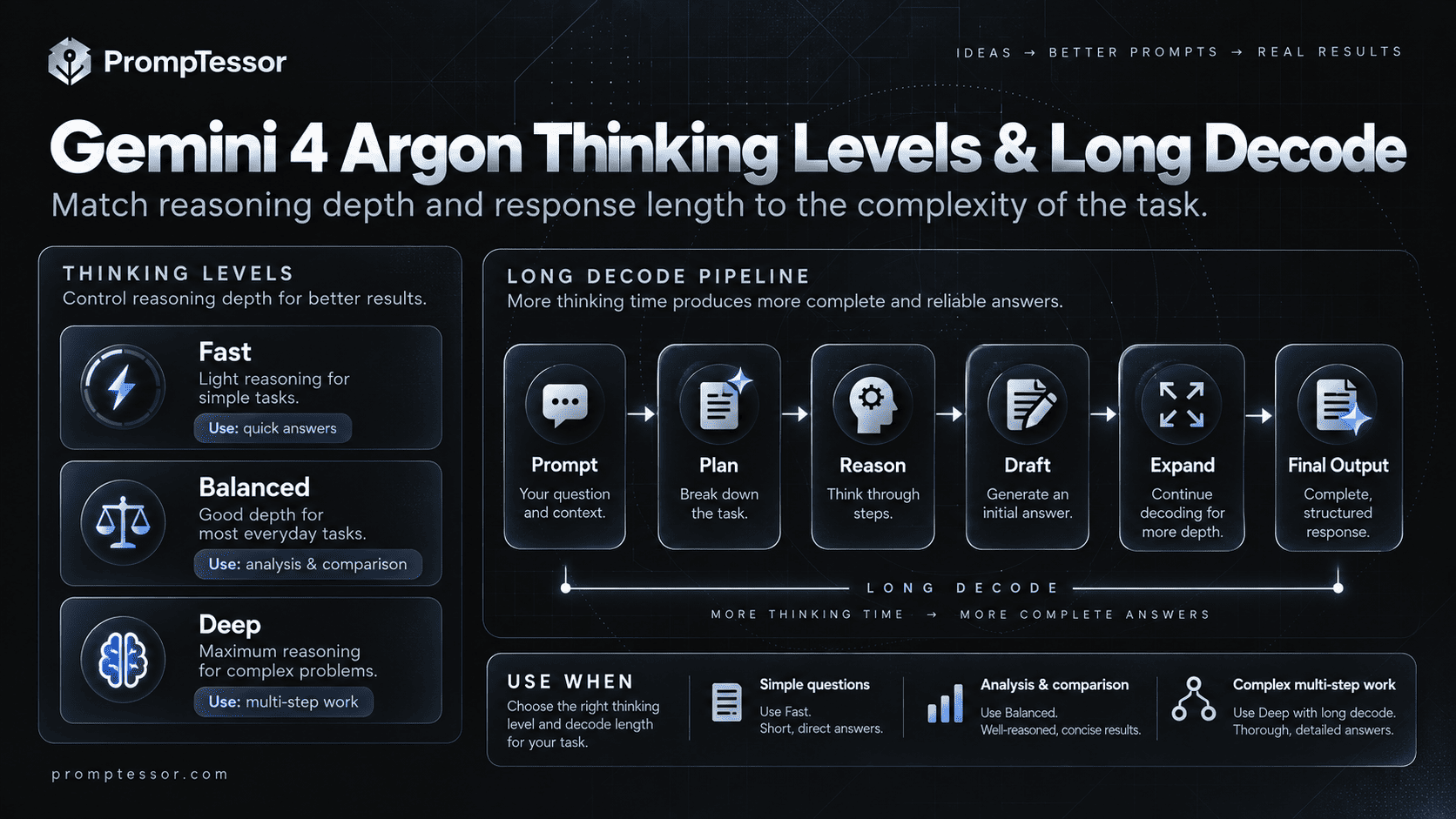
Before writing a single line of production code, examine the technical characteristics that determine whether Gemini 4 Argon fits demanding use cases. Model cards are the primary source, but they need to be read skeptically and cross-referenced with your own evaluations.
Technical Deep Dive: Reasoning, Tool Use, and Long-Context Workloads
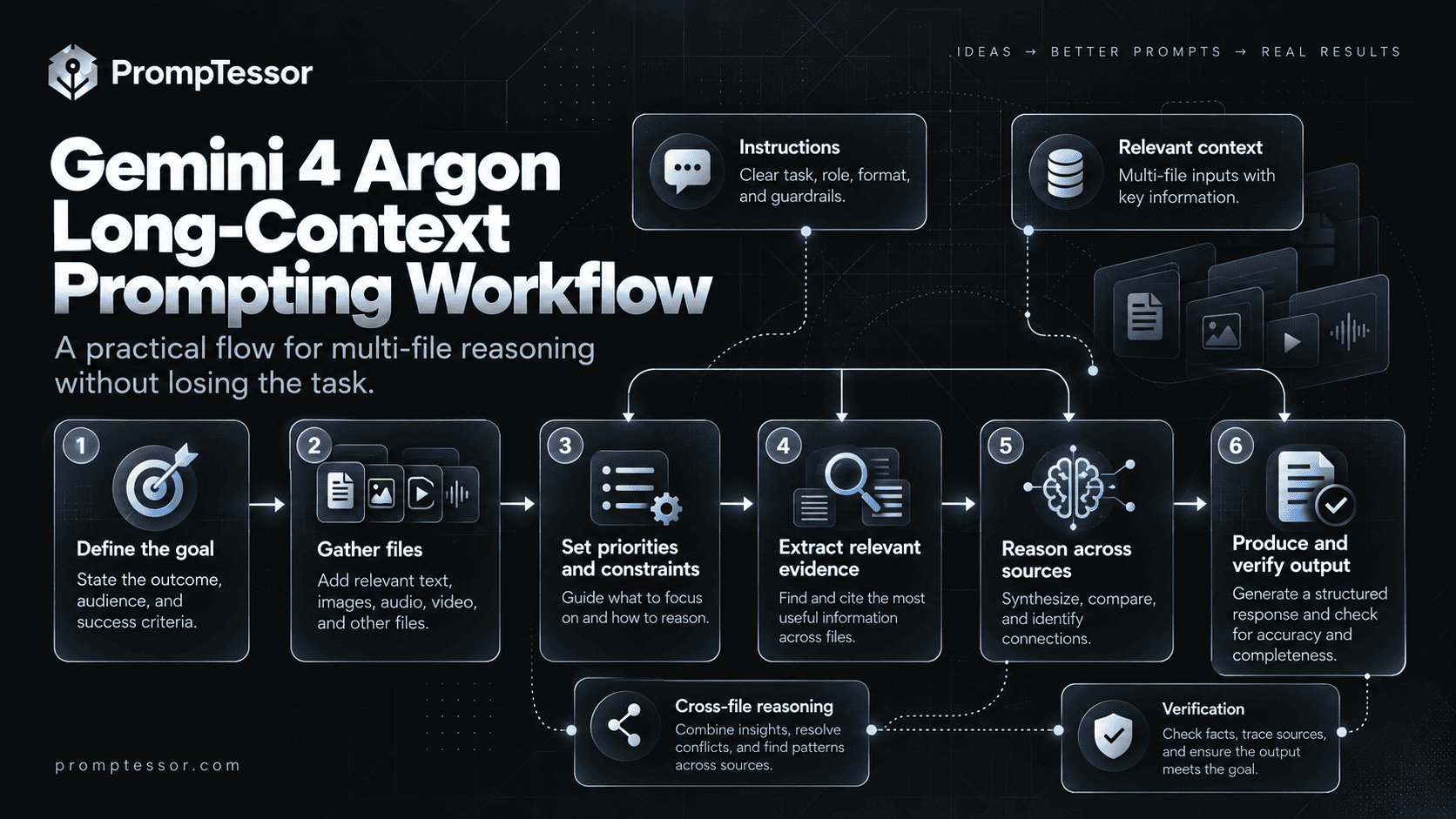
Verify reasoning quality on multi-step tasks, not single-shot Q&A. Check how the model behaves when tool calls fail: does it retry, hallucinate a result, or halt? Probe determinism by running identical prompts at temperature 0 and confirming output stability. Test context limits near the edge—20K, 100K, and up to the advertised maximum—because effective context is often lower than the marketed number due to quality degradation mid-window.
Multimodal AI API Capabilities: Text, Image, Audio, and Video

Multimodal support changes your API design fundamentally. Images and audio need to be uploaded, stored, and referenced by URI or inline payload. Output can include structured JSON, images, or video frames, each with different latency and cost profiles. When you're using an image generation API or video generation API alongside reasoning, a single workflow may traverse several modality boundaries. Design your request/response contracts to be modality-agnostic from day one.
What to Verify in Official Documentation and Model Cards

Confirm quotas, supported modalities, per-request size limits, versioning policy, and deprecation timelines. Ask specifically: what happens when Google rotates a model alias? How are breaking changes communicated? Are there regional restrictions on multimodal inputs? These are the details that decide whether an integration survives its first year.
Google Gemini Integration: Developer Checklist for Direct Access
Direct integration with Google is often the fastest path to a new model, but it demands upfront diligence.
Authentication, SDKs, Quotas, and Regional Availability
Expect OAuth or service-account credentials, official Python and Node SDKs, and region-scoped quotas. Verify whether your target region is supported, whether enterprise tiers change limits, and whether per-project or per-key rate limits constrain bursty workloads.
Model Versioning and Deprecation Planning
Google typically uses aliases like gemini-<version> versus immutable versioned IDs. Pin to versioned IDs in production and reserve aliases for experimentation. Build a deprecation calendar into your release process—model churn is one of the most under-budgeted risks in AI deployments.
Direct Google Gemini Integration vs a Gemini API Gateway
Direct integration maximizes access to Google's newest features and tuning options. A gateway adds abstraction, but buys portability, unified auth, and multi-model routing. If you expect only one provider forever, direct wins. If you're building a durable AI platform, a gateway is usually smarter. You can review supported options on the CCAPI model catalog before committing.
Gemini API Gateway vs Direct Integration: Access, Control, and Lock-In
This is where architecture decisions bite. Lock-in isn't just about pricing—it's about the cost of migrating prompts, tools, evaluation harnesses, and observability whenever a model is deprecated or outperformed.
Unified AI API Access Across OpenAI, Anthropic, and Google
A unified AI API layer normalizes request/response schemas across providers, letting teams A/B test GPT, Claude, and Gemini with the same client code. This dramatically reduces integration overhead for text, image, audio, and video workflows, and lets you swap providers when a new release wins on your benchmarks.
Transparent Pricing and Zero Vendor Lock-In with CCAPI
CCAPI emphasizes transparent pricing and provider flexibility. That means you can see per-token and per-modality costs up front on the pricing page, and you're not committing your roadmap to a single provider's model cycle. The trade-off: gateway features can lag provider-native features by days or weeks. Confirm current support and pricing for Gemini 4 Argon before routing production traffic.
Routing, Fallbacks, Observability, and SLA Considerations
Gateway platforms should offer failover between models, structured logging, usage analytics, and latency monitoring. Ask specifically about SLA guarantees, regional failover behavior, and whether logs can be exported to your own observability stack. The best gateway is one that doesn't hide these trade-offs behind a friendly dashboard.
Benchmarking Hard Problems: What to Verify in the Gemini 4 Argon API Claims
Public benchmarks like MMLU or HumanEval are useful signals, but they're increasingly saturated and often weakly correlated with real enterprise performance.
Task-Specific Evaluation Beyond Public Benchmarks
Build a task suite from your actual workload: code review, long-document QA, multi-turn tool use, math word problems, image-grounded reasoning, and domain-specific tasks. Score correctness, completeness, and formatting compliance. A model that scores slightly lower on MMLU but 15% higher on your tasks is the better production choice.
Latency, Throughput, and Cost-Per-Outcome Metrics
Token price is a vanity metric. What matters is cost per successful outcome. If Gemini 4 Argon completes a task in one turn that cheaper models need three turns to finish, the effective cost may be lower despite a higher per-token price. Track success rate × median latency × total spend per task completion, per workflow.
Building an Internal Evaluation Harness
Maintain a golden dataset of representative tasks with human-reviewed outputs. Version prompts, model IDs, and temperature settings together. Run regression tests on every model change and every prompt change. Without this discipline, you'll make blind decisions the first time Google ships an update.
Real-World Implementation: Deploying the Gemini 4 Argon API in Production
Pilots fail for organizational reasons more often than technical ones. Choose workloads with clear owners, measurable KPIs, and reversible failure modes.
Pilot Design: Selecting High-Value Hard Problems
Good pilot candidates: internal research synthesis, code migration assistance, multimodal document extraction, and complex customer-support triage. Avoid external-facing or high-compliance workflows until you have production-grade observability and cost controls.
Orchestration Patterns for Multimodal AI API Workflows
Use prompt chaining for multi-step reasoning, tool use for retrieval and calculation, and validation steps between every stage. For multimodal tasks—especially text to video or cross-modal reasoning—add human review checkpoints before delivery. Never let a single model call silently determine an external action.
Using CCAPI as a Unified AI API Access Layer
During pilots, CCAPI can simplify access to major models so your team can benchmark Gemini 4 Argon against OpenAI and Anthropic without rewriting integration code. It's particularly useful for teams exploring text, image, audio, and video generation workflows in parallel. Verify current model support and pricing before routing production traffic, and check the API token console to scope credentials per environment.
Lessons from Production: Common Pitfalls and Mitigation
Context Overflows, Hallucinations, and Multimodal Input Failures
Context overflows usually surface as silently truncated inputs, not errors. Chunk long documents, use retrieval to ground queries, and validate multimodal inputs before sending them. Add confidence-threshold escalation so uncertain outputs route to human review rather than external delivery.
Cost Overruns and Rate-Limit Bottlenecks
Set per-environment budget alerts, hard caps on daily spend, and retry logic with exponential backoff. Rate-limit bottlenecks often appear as tail-latency spikes, not 429 errors—monitor p95 and p99 carefully.
Governance and Data-Retention Mistakes
Chat logs and multimodal caches frequently retain data longer than your privacy policy promises. Define retention windows, encrypt cached inputs, and apply the same data classification rules to AI pipelines that you apply to any other data store.
Security, Privacy, and Governance for Multimodal AI Workloads
Data Retention, PII, and Sensitive Multimodal Inputs
Images of IDs, audio recordings, and scanned documents frequently contain regulated data. Strip or hash identifiers, enforce redaction on audio transcription, and never assume the provider is retaining data per your policy—verify it contractually.
Access Controls, Audit Logs, and Model Routing Policies
Use role-based access on API keys, require approvals for high-risk workflows, and log every routing decision. If your gateway can silently route requests to different providers, you need to know which provider served which request for compliance purposes.
Compliance Questions to Ask Before Rollout
Ask about data residency, subprocessor lists, breach notification timelines, and retention defaults—for every provider and every gateway. If you're using an MCP server or Claude Code MCP for agentic workflows, extend the same scrutiny to tool integrations that may access sensitive systems.
Pros, Cons, and When to Use Gemini 4 Argon
Where Gemini 4 Argon May Excel
If the announced capabilities hold up in your evaluations, Gemini 4 Argon could be strong for complex reasoning, long-context analysis, and multimodal tasks that benefit from Google's ecosystem. Enterprise teams already standardized on Google Cloud will find integration friction lower.
Limitations and When Not to Use It
Smaller, cheaper, or specialized models often win on latency-sensitive, high-volume classification. On-premises deployments may be required for regulated industries. Don't standardize on a single hard-problem model—keep alternatives warm.
Alternatives and Complementary Models in a Unified Gateway
A multi-model strategy—OpenAI for general reasoning, Anthropic for long-form reasoning, Google for multimodal, specialized models for niche tasks—is the pragmatic default. CCAPI's bundling of model access reduces dependence on any single provider while preserving optionality.
Advanced Techniques for Hard-Problem Workflows
Decomposition, Self-Consistency, and Verification Loops
Break complex tasks into sub-questions, sample multiple outputs at higher temperature, and pick the consensus. Add a verification pass by a second model or a rules engine before delivery. This trades cost for reliability—often the right trade.
RAG and Tool-Augmented Reasoning with Gemini
Combine retrieval-augmented generation with external tools like calculators, code execution sandboxes, and structured-output parsers. Always validate tool outputs before feeding them back into the model—untrusted tool results are a top hallucination vector.
Multimodal Fusion and Human-in-the-Loop Review
For workflows combining text, image, audio, and video, stage reviews by confidence tier. Low-confidence multimodal extractions route to human reviewers; high-confidence outputs ship automatically. Reserve the most expensive path—full human review—for the highest-stakes slices.
Industry Context and Expert Perspectives: What the News Coverage Misses
Competitive Landscape: OpenAI, Anthropic, Google, and Specialized Models
The general-purpose frontier is converging, but specialization still beats generalists on narrow tasks. Providers like DeepSeek, Qwen, and MiniMax increasingly offer compelling specialized APIs—the practical play is to route each task to whichever model wins on your harness.
Hidden Insights: Orchestration Costs, Deprecation Risk, and Integration Debt
The most under-discussed cost of Gemini 4 Argon adoption isn't tokens—it's the orchestration, evaluation, and observability scaffolding you must build. Model churn compounds this. Teams that build a strong internal harness once can swap models cheaply later; teams that don't will pay migration costs on every release cycle.
How CCAPI Reduces Integration Complexity Without Hiding Trade-Offs
CCAPI's value is at the access layer: unified authentication, one pricing surface, and model flexibility. It doesn't eliminate the need to evaluate models, verify terms, or manage governance. If you want to explore MCP-based workflows, the MCP integration page shows how to wire tools into gateway-routed workflows. Top-up management lives at the console top-up page, which keeps billing in one place across providers.
Practical Evaluation Checklist: Gemini 4 Argon API Through CCAPI
Business Fit and Workload Prioritization
Does the workload justify premium pricing? What's the cost of a wrong answer? Which users are affected? What's the data sensitivity class? Is the workload reversible if quality drops?
Technical Validation and Cost Modeling
Have you built task-specific evals? Tested multimodal quality on your inputs? Measured p50/p95 latency? Modeled cost per successful outcome, not just per token? Identified fallback models?
Procurement, Governance, and Rollout Readiness
Is pricing transparent across all providers? Have you documented vendor lock-in mitigations? Completed security review? Defined pilot success metrics? Assigned owners for model deprecation tracking?
Whether you go direct with Google or route through a gateway like CCAPI, the discipline that separates successful deployments from expensive prototypes is the same: evaluate on your real tasks, verify against official documentation, and plan for the model to change under you. Gemini 4 Argon API may or may not be the right fit for your hardest problems—but with a solid evaluation harness and a flexible access layer, you'll be able to answer that question with data instead of marketing copy.