
Fallback model for Nano Banana Pro - Complete Analysis
Nano Banana Pro Fallback: A Deep-Dive Guide to Reliable Image Generation APIs
Nano Banana Pro fallback is not a nice-to-have error handler. It is a reliability design pattern for production image generation APIs. When a primary image model is rate-limited, degraded, deprecated, or blocked by a regional incident, a planned fallback path keeps jobs moving without silently destroying quality, brand consistency, or cost control. This deep dive covers how fallback works, how to design it for Nano Banana Pro workloads, and how a unified AI API gateway such as CCAPI can reduce operational complexity.
Why AI Model Fallback Matters for Nano Banana Pro
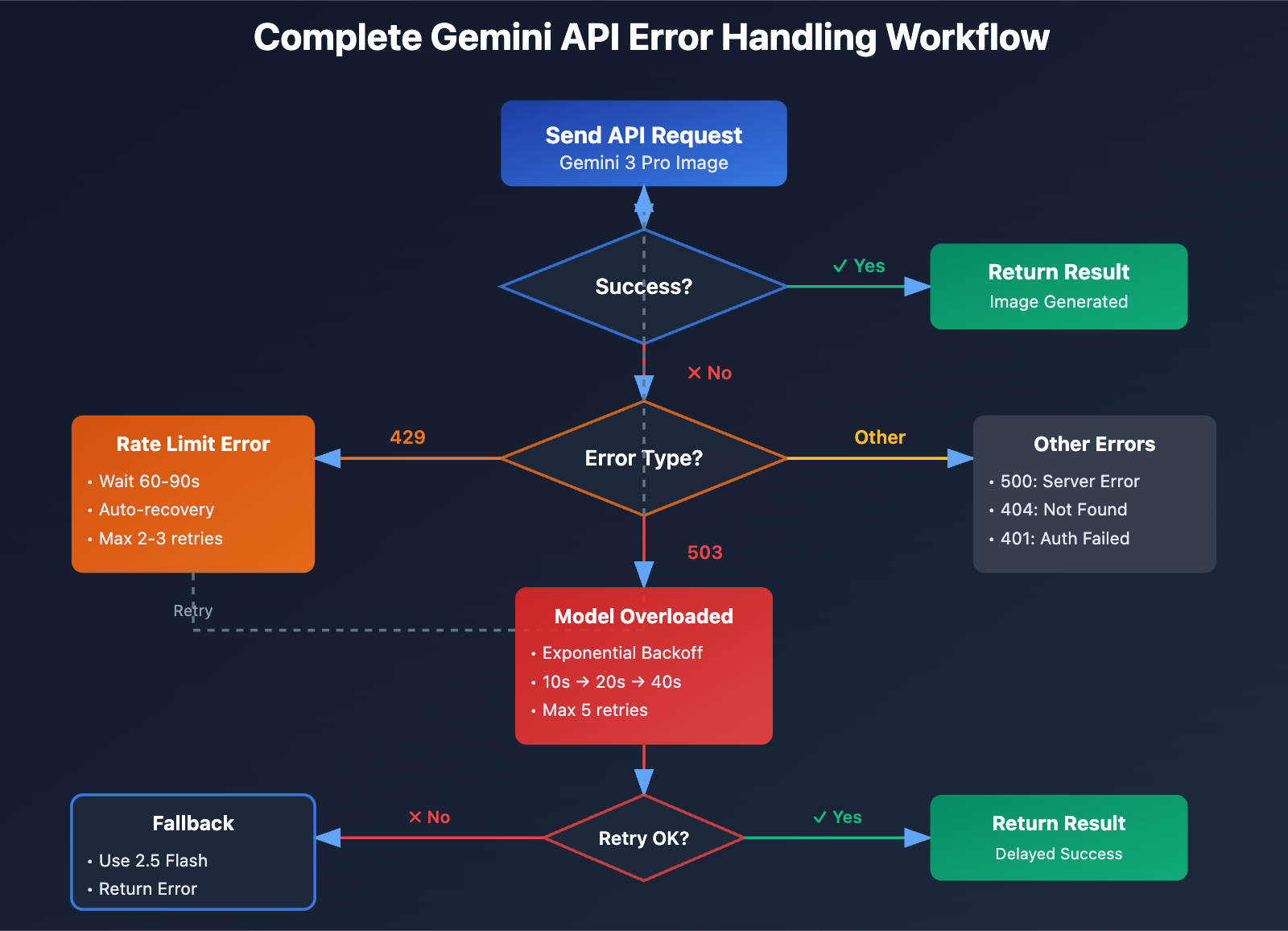
Image generation is now part of product, marketing, commerce, and support workflows. A failed request can block a product listing, delay a campaign, or leave an end user staring at an unfinished creative. In practice, the most expensive incidents are rarely total outages. They are partial degradations: HTTP 429 spikes during bursts, intermittent 5xx responses, latency that climbs past a user-facing timeout, quota exhaustion near the end of a billing cycle, or a model version change that alters output style.
Nano Banana Pro fallback matters because these failures are operational facts, not edge cases. A mature system treats fallback as a reliability strategy with explicit policy, observability, and quality gates. Without that discipline, teams either retry blindly and amplify load, or switch models ad hoc and create silent style drift.
What Nano Banana Pro Fallback Means in Production
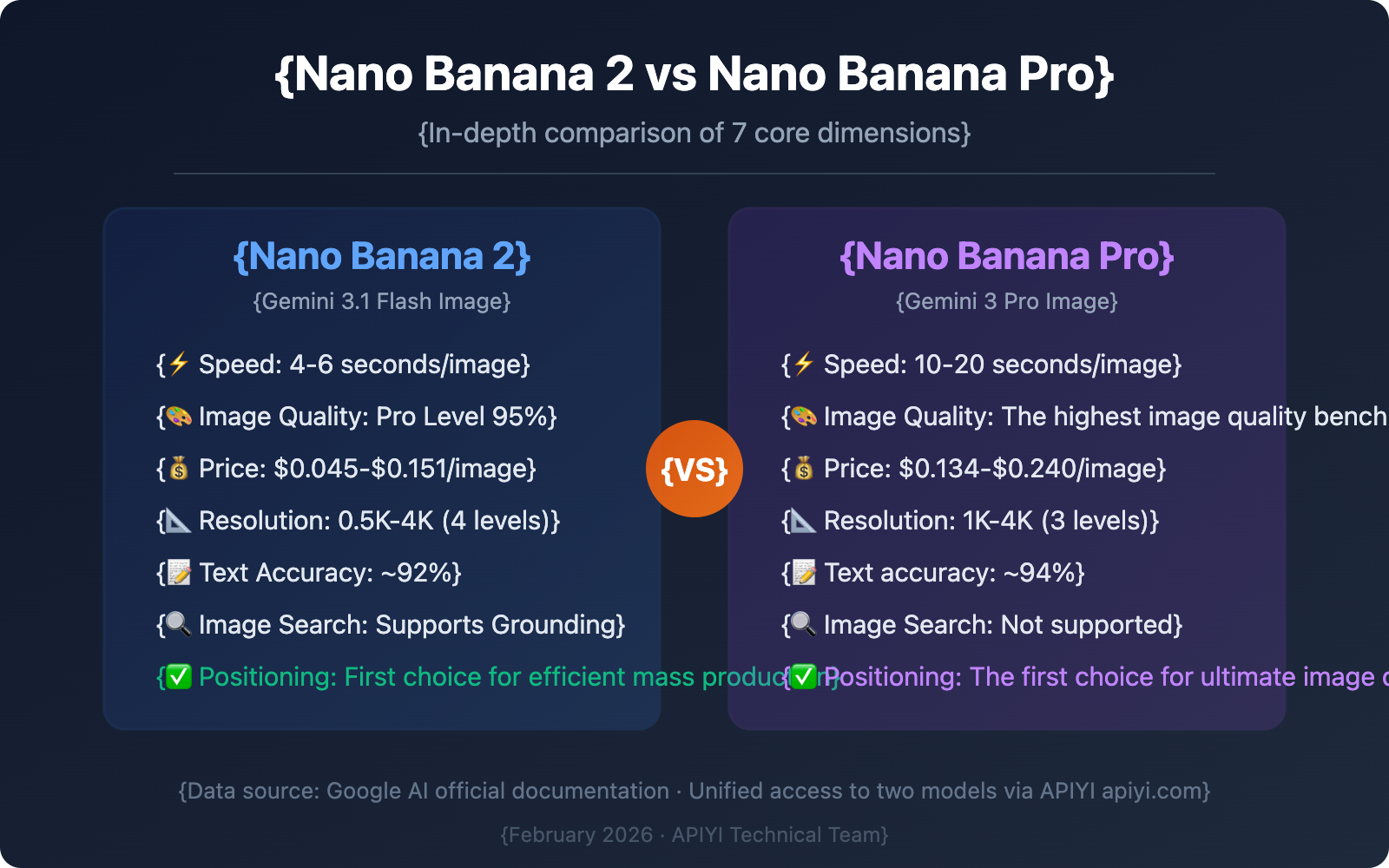
Nano Banana Pro fallback is the planned substitution of a primary image model with a compatible secondary model when availability, quality, cost, latency, or policy thresholds are breached. The key word is planned. Fallback should be triggered by a policy decision, not by a developer manually changing an endpoint during an incident.
Fallback is also different from a retry. A retry repeats the same request against the same model or provider. A fallback changes the execution path to another model, provider, region, or configuration. Retries are useful for transient blips; fallback is what protects the workflow when the primary path is unlikely to recover within the job’s latency budget.
Typical Failure Modes That Trigger AI Model Fallback
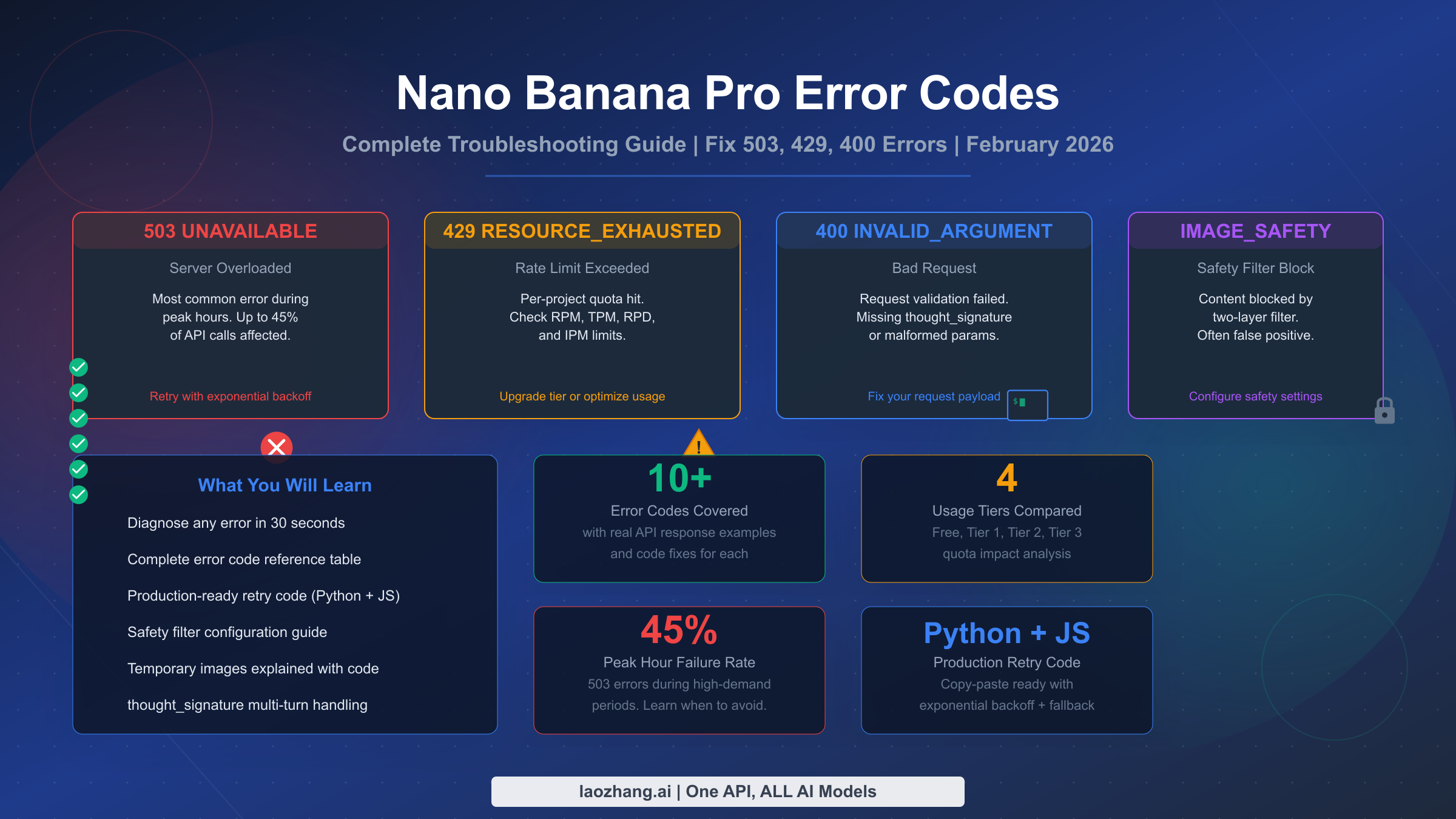
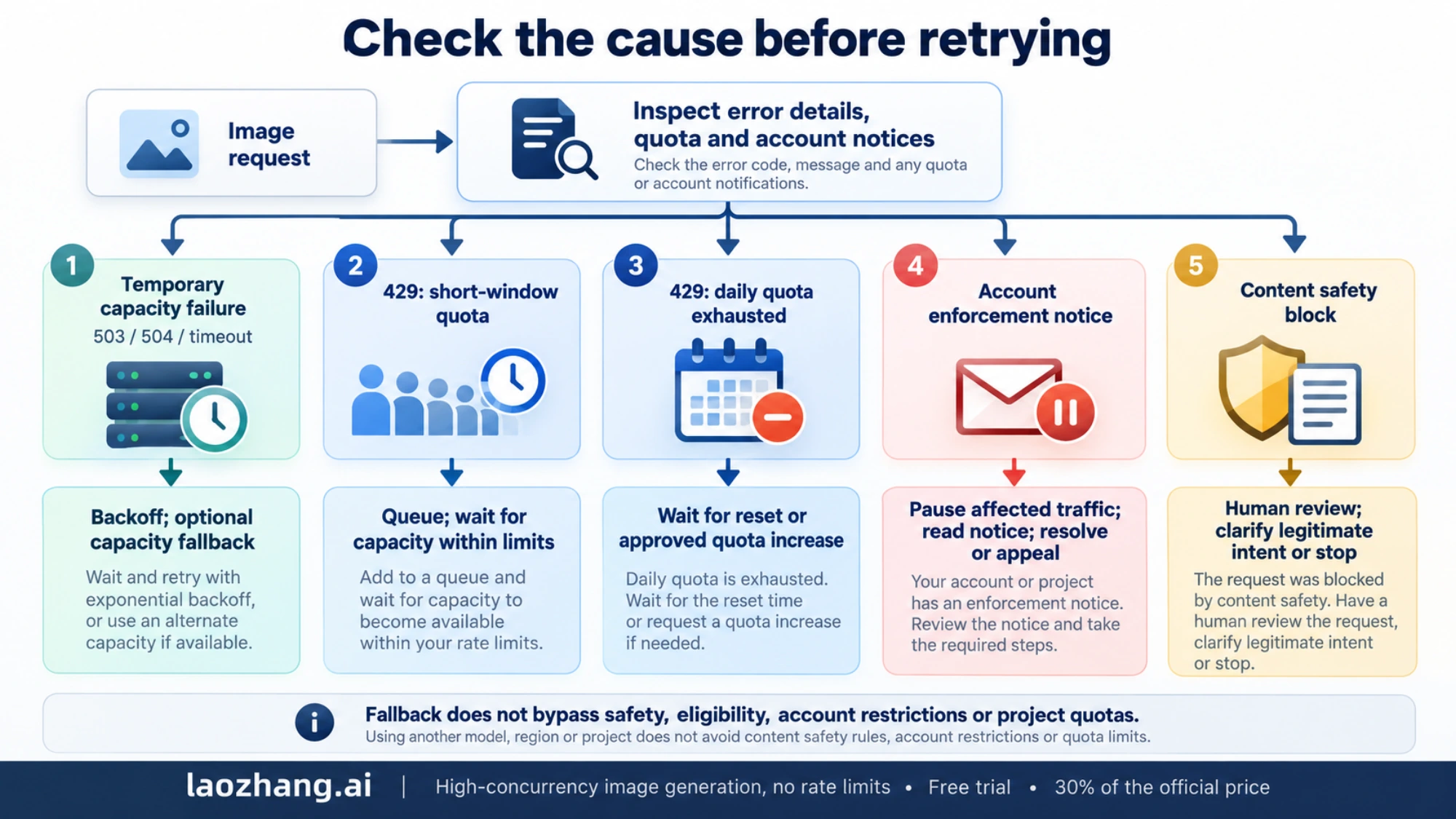
Not every error deserves the same response. The hidden insight is to classify triggers as transient versus permanent before invoking fallback. A transient 429 should usually trigger bounded backoff and retry. A permanent content-filter rejection should not be retried against the same model; it may need a policy decision, prompt review, or manual escalation.
| Trigger | Typical classification | Recommended first action |
|---|---|---|
| Provider incident or regional outage | Transient or regional | Route to another provider or region |
| HTTP 429 rate limit | Transient | Backoff, then fallback if budget exhausted |
| HTTP 5xx or gateway timeout | Transient | Retry with jitter, then fallback |
| Content-filter rejection | Permanent for that prompt | Do not retry blindly; review or escalate |
| Model deprecation or version change | Permanent | Update prompt templates and fallback policy |
| Budget cap or quota exhaustion | Policy-driven | Queue, degrade, or fallback within cost ceiling |
A common mistake is treating every failure as retryable. That increases queue depth, burns budget, and delays the moment when the system should have switched to a safer fallback path.
Why Image Generation Pipelines Need More Than Basic Retries
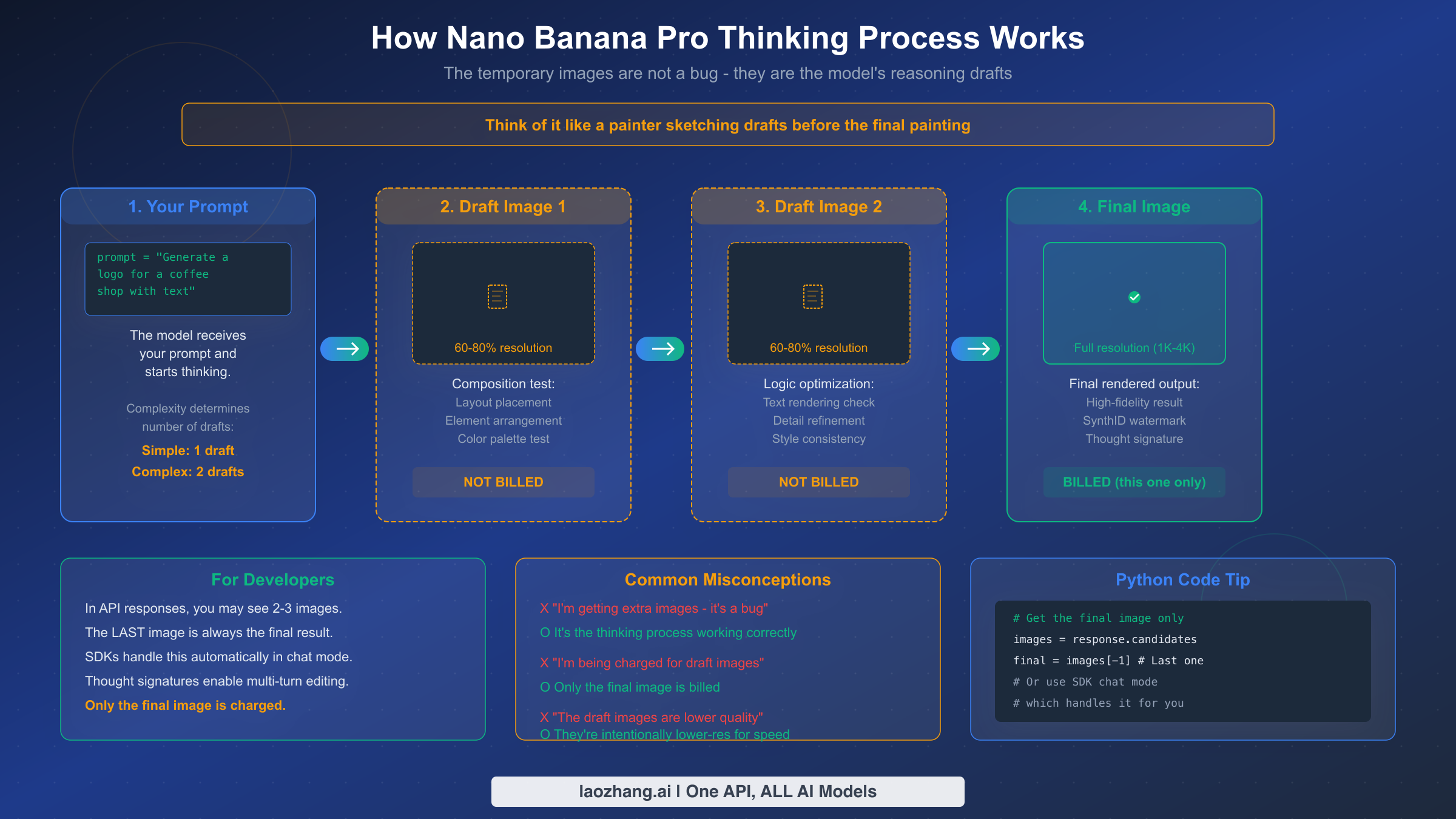
Text APIs often tolerate retries because the output is easy to compare and the cost per call is low. Image generation APIs are harder. A retry can produce a different seed, composition, lighting, aspect ratio, or safety-filter outcome. Users notice style inconsistency even when the image is technically valid.
Image workflows also carry harder parameter constraints: negative prompts, seeds, resolution, aspect ratio, style controls, and safety filters differ across providers. Blind retries can increase cost and latency without improving output quality. For brand assets, a failed retry that produces a near-miss image can be worse than a clear fallback message.
How AI Model Fallback Works in Image Generation APIs

A production fallback layer sits between application code and provider APIs. It performs request routing, health checks, policy evaluation, retry budgeting, and model substitution. The goal is not to hide every failure. The goal is to preserve job completion while keeping cost, latency, and quality within defined bounds.
Request Routing, Health Checks, and Retry Logic
A gateway or orchestration layer decides which model receives a request based on policy, provider health, queue depth, and job priority. Health checks should include more than “is the endpoint reachable?” They should track recent error rates, p95 latency, rate-limit signals, and quality-check failures.
Retries should be bounded. Use a retry budget per job and per provider window. Add exponential backoff with jitter, and fail over only when the retry budget is exhausted or the error classification says the primary path is unlikely to recover quickly.
def route_image_job(job, primary, fallback, health):
    if health.is_healthy(primary) and job.cost_ok(primary):
        return primary
    if job.priority == "enterprise" and health.is_degraded(primary):
        return fallback
    if health.error_rate(primary) > job.error_budget:
        return fallback
    return primary
Fallback vs Failover vs Retry: Key Differences
Teams often use these terms interchangeably, which leads to weak incident playbooks. They solve different problems.
| Pattern | What changes | Best used for |
|---|---|---|
| Retry | Same request, same target | Transient blips, short rate-limit windows |
| Fallback | Substitute model or provider | Primary model unavailable or unsuitable |
| Failover | Shift traffic to standby provider or region | Infrastructure-level outages and resilience |
A mature AI model fallback workflow needs all three. Retry handles the smallest transient failures. Fallback protects the job when the primary model cannot deliver within policy. Failover protects the platform when an entire provider or region becomes unreliable.
Prompt and Parameter Compatibility Across Image Generation APIs
The hardest part of fallback is not routing. It is compatibility. A one-to-one swap between image models often fails because prompts, negative prompts, seeds, aspect ratios, resolution limits, and style controls are not portable. Safety filters also differ. A prompt that passes one provider may be rejected by another.
Build a compatibility layer that normalizes the request into your own internal schema, then translates it into provider-specific parameters. Version prompts and keep model-specific templates. Run seed compatibility checks where deterministic output matters. Audit safety-filter differences before exposing a fallback to users.
Aligning with Official Image Generation API Documentation
Keep the fallback layer documentation-ready. Store provider-specific error codes, rate-limit semantics, timeout behavior, and supported image formats in a versioned configuration file. When official documentation changes, the routing policy should change with it. Since no external references were supplied for this article, treat this subsection as a checklist: map every provider error code to retry, fallback, queue, or escalate before production launch.
Designing a Nano Banana Pro Fallback Strategy
A Nano Banana Pro fallback strategy starts with policy, not code. Define what “good enough” means for each workload, how much latency is acceptable, and which fallback models are allowed for which use case. Then encode those decisions into routing rules and quality gates.
Setting Fallback Triggers and Service-Level Objectives
Use SLOs and error budgets to decide when fallback is allowed. A timeout threshold should reflect user expectations, not provider defaults. A quality score threshold should reflect brand risk, not just visual plausibility. Add cost ceilings so fallback does not quietly become more expensive than the primary path.
Differentiate user-facing fallback from internal fallback. Internal fallback can be aggressive for testing and batch jobs. User-facing fallback should be conservative, especially for enterprise brand assets. Manual override rules are also useful for high-value jobs that require human review before substitution.
Choosing Compatible Fallback Models by Use Case
There is no universal fallback model. Choose based on style consistency, latency, and cost.
| Use case | Fallback priority | Main risk |
|---|---|---|
| Photorealistic product images | Style and lighting consistency | Subtle brand mismatch |
| Illustrations and editorial art | Prompt adherence and composition | Tone drift |
| Social media creatives | Latency and aspect-ratio support | Cropping or text layout issues |
| Text-heavy graphics | Text rendering reliability | Unreadable or misspelled copy |
| Enterprise brand assets | Safety filters and review workflow | Brand risk and compliance |
For high-volume social creatives, a faster fallback model may be acceptable. For product or enterprise assets, a slower but more style-consistent model is usually better.
Adapting Prompts, Seeds, and Safety Filters Across Models
A one-to-one model swap often fails because prompts are not portable. Use versioned prompts and model-specific prompt templates. Check seed compatibility if your workflow depends on reproducible variations. Audit safety filters because rejection rates can differ sharply across providers.
Watch for silent style drift. This is the hidden risk: fallback works, jobs complete, uptime looks healthy, but output gradually moves away from brand style. The fix is not more retries. It is automated output checks, human review sampling, and per-category benchmarking.
Multi-Provider Failover for Image Generation API Workloads
Multi-provider failover improves resilience for image generation API traffic by reducing dependence on a single provider’s health, rate limits, and regional availability. A routing layer such as CCAPI can abstract provider differences and reduce the amount of custom failover code your team must maintain.
Provider-Level and Model-Level Failover Patterns
Compare patterns before choosing. Active-active spreads traffic across providers but increases consistency risk. Active-passive keeps a standby provider ready but may waste capacity. Weighted routing is useful for gradual migrations. Priority groups work well when one provider is preferred and another is a known fallback. Model-level substitution is narrower and often better for quality-sensitive workloads.
Provider-level failover is better when an entire provider is degraded. Model-level fallback is better when a specific model is rate-limited, deprecated, or failing quality checks.
Circuit Breakers, Backoff, and Idempotent Image Jobs
Circuit breakers stop sending traffic to a failing path after a threshold. Exponential backoff reduces pressure during rate-limit events. Dead-letter queues preserve jobs that cannot complete after retries and fallback. Idempotency keys prevent duplicate image generation charges when clients retry or when asynchronous workers replay jobs.
A common production mistake is retrying a job that already succeeded but timed out at the client. Idempotency keys and job-state checks prevent duplicate charges and repeated failed jobs.
Observability for Multi-Provider Failover
Track fallback rate, provider error rate, p95 latency, success-after-fallback rate, and cost per successful image. Add traces that show which provider, model, prompt template, and policy rule handled each job. Alert on quality drift, not just availability. Uptime can be perfect while brand consistency quietly degrades.
Zero Lock-In AI API Architecture with CCAPI
CCAPI unified AI API gateway is a practical example of a unified multimodal AI API gateway that provides access to major AI models from providers such as OpenAI, Anthropic, and Google for text, image, audio, and video generation. It emphasizes transparent pricing and zero vendor lock-in, which matters when fallback policy must be both technical and financial.
How a Unified Gateway Simplifies AI Model Fallback
A gateway abstracts provider APIs, centralizes routing policy, and reduces custom failover code. Instead of hard-coding provider-specific logic in every service, teams can define fallback rules in one place. This is especially useful for image generation API workloads that need consistent authentication, retries, and model substitution behavior.
Transparent Pricing and Model Substitution Policies
Cost visibility is part of fallback reliability. Review CCAPI pricing when defining budget caps, model substitution approval rules, and chargeback reporting. Transparent pricing helps teams choose fallback paths without surprise cost spikes. It also makes it easier to explain why a job used a secondary model.
Reducing Vendor Lock-In Without Sacrificing Output Quality
Zero lock-in AI API design supports portability, but portability alone is not enough. Pair it with quality gates: brand-style guardrails, prompt libraries, and automated output checks. Review supported models before switching models in production, and keep a human review path for high-value assets.
Implementation Guide: Adding a Fallback Model for Nano Banana Pro
Adding a fallback model for Nano Banana Pro is a policy and contract exercise before it is a coding task. Start with a clear API contract, a decision matrix, and user-facing messaging that does not confuse degraded mode with failure.
Prerequisites and API Contract Design
Define request and response schemas, supported image formats, timeout settings, idempotency keys, authentication, and an error taxonomy. Your internal schema should not mirror one provider too closely. A CCAPI-style gateway can reduce integration work by exposing a unified interface, but your application still needs its own error classification and job-state model.
Building the Fallback Decision Matrix
Map error type, severity, cost impact, and quality risk to an action: retry, fallback, queue, degrade gracefully, or alert. Include manual escalation for high-value enterprise jobs.
| Error type | Severity | Action |
|---|---|---|
| 429 rate limit | Low to medium | Backoff, then fallback if retry budget exhausted |
| 5xx provider error | Medium | Retry once, then fallback |
| Timeout beyond SLO | Medium to high | Fallback or queue |
| Content-filter rejection | High for that prompt | Review, revise prompt, or escalate |
| Quality-score failure | High | Fallback only to approved model |
| Budget-cap breach | Policy-driven | Queue or degrade, do not silently overspend |
Error Handling and User-Facing Messaging
Communicate degraded mode without confusing users. For asynchronous jobs, show status such as “generating with an alternate model” only when it matters to the user. Avoid exposing raw provider errors. Use retry messaging with clear timing, partial-success responses where appropriate, and internal alerts for fallback spikes.
Quality and Cost Trade-Offs in Nano Banana Pro Fallback
Fallback can protect user experience, but it can also quietly reduce quality. Measure both. The question is not “did the job complete?” It is “did the job complete at acceptable quality, latency, and cost?”
Benchmarking Style Consistency and Prompt Adherence
Use human evaluation, automated image similarity scoring, brand-style checks, and prompt-adherence tests. Benchmark fallback models per prompt category, not just overall. A fallback model that performs well for illustrations may fail on product photography or text-heavy graphics.
Calculating Cost per Successful Image
Track cost per successful output, including retries, failed generations, fallback usage, storage, and review time. Compare that with simple per-call pricing. A cheaper model with a high failure rate can be more expensive than a reliable model with a higher unit price.
Latency Budgets and Throughput Planning
Plan for p95 and p99 latency, queue depth, async processing, and burst traffic. Fallback models with different speed profiles affect user experience and infrastructure load. A fast fallback may preserve latency but reduce quality; a slow fallback may preserve quality but break the user-facing SLO.
Testing and Monitoring AI Model Fallback
Validate fallback reliability before and after launch. Testing only the happy path is not enough. You need to prove that the fallback path activates, completes jobs, and preserves quality under realistic failure conditions.
Chaos Testing Provider Outages
Simulate 429s, 5xx errors, timeouts, region failures, and degraded quality scores. Verify that the fallback path activates correctly and that user-facing jobs complete. Test idempotency by replaying jobs. Test circuit breakers by forcing sustained failures.
Canary Fallbacks and A/B Tests
Use canary releases for new fallback models. Run A/B tests comparing quality, cost, and latency. Avoid exposing high-value brand assets to untested fallbacks. Keep a manual review gate for enterprise jobs until the fallback model has passed category-specific benchmarks.
Metrics That Reveal Silent Quality Drift
Monitor fallback rate, success-after-fallback rate, style-drift score, safety-filter mismatch rate, cost per successful image, and manual review rate. Uptime metrics alone are insufficient. A system can be available and still be producing outputs that violate brand standards.
Common Pitfalls and When Not to Use AI Model Fallback
The biggest pitfall is silent quality degradation. Fallback can produce outputs that are technically valid but stylistically wrong, safety-filter inconsistent, or unsuitable for regulated use cases. That creates brand risk long after the incident is over.
Do not use automatic fallback for legal, regulated, or brand-critical assets unless the fallback model has passed explicit quality gates and approval rules. For high-value enterprise jobs, prefer queueing or manual escalation over silent substitution. Fallback should be observable, policy-driven, and reversible.
Conclusion
Nano Banana Pro fallback is a production reliability pattern, not an emergency hack. It requires explicit triggers, compatible model selection, prompt and parameter normalization, idempotent job handling, and quality-aware observability. A unified AI API gateway such as CCAPI can simplify routing and reduce vendor lock-in, but the policy and quality gates remain your responsibility. Treat Nano Banana Pro fallback as part of your image generation API architecture, and you can preserve uptime without quietly sacrificing brand quality or cost control.