
Confidence Thresholds for Model Escalation Routing
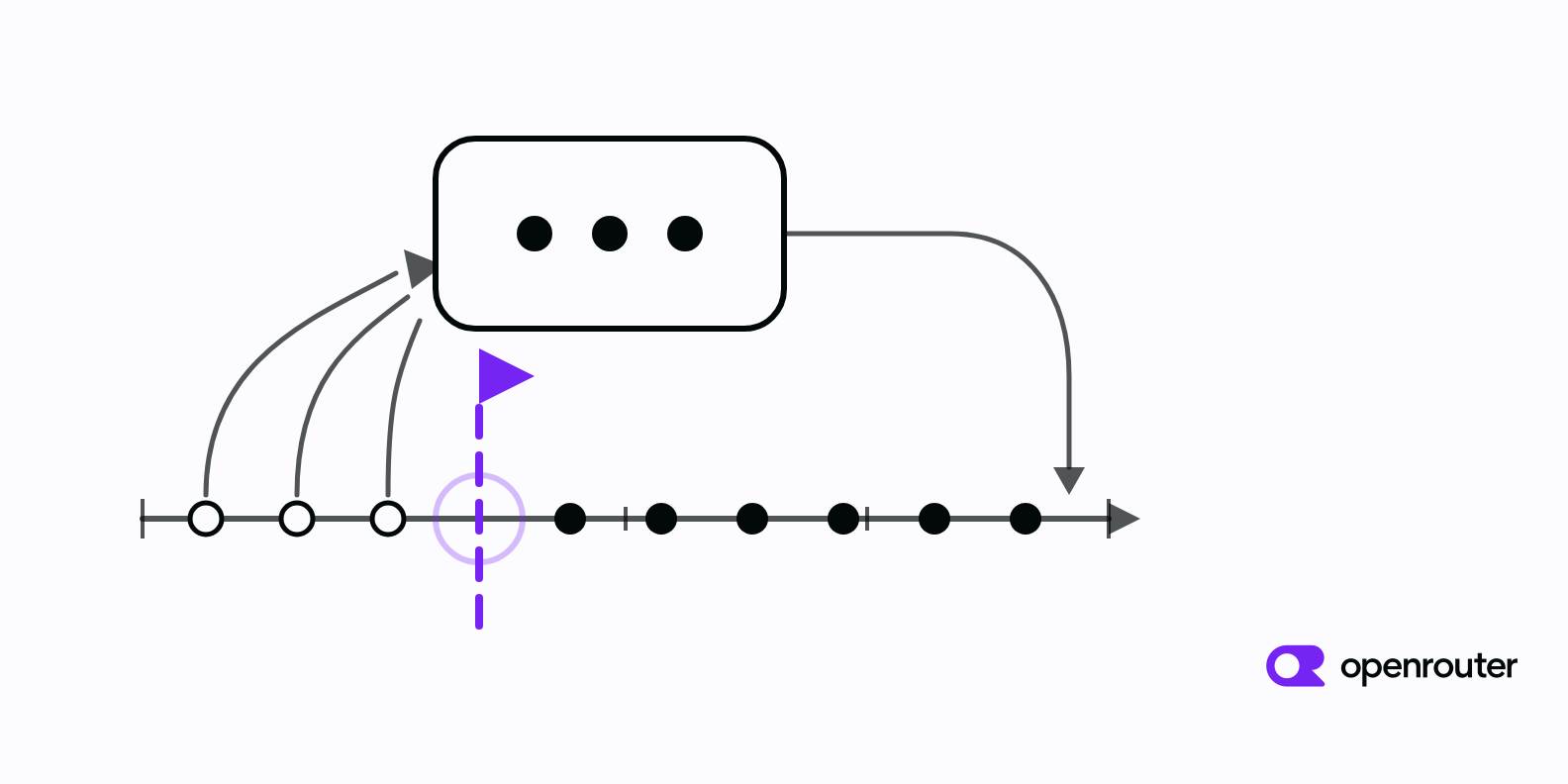
Confidence Threshold Model Routing: A Deep Dive into LLM Escalation and Fallback Design
Every production LLM system eventually hits the same wall. The model that is good enough for your hardest queries is too slow and too expensive for the other 90% of traffic, and the model that comfortably handles that 90% will embarrass you on the rest. Confidence threshold model routing is the discipline of resolving that tension per request: measure how uncertain a model is, compare that measurement against a policy threshold weighted by business risk, and escalate only when the uncertainty justifies the cost.
This article goes deep on the mechanics — how confidence signals are actually computed, how thresholds are calibrated rather than guessed, how escalation tiers map across providers, and what breaks in production when teams treat a threshold as a constant instead of a living parameter. If you are building a gateway that routes between OpenAI, Anthropic, Google, and cheaper open-weight endpoints, this is the design surface you will spend most of your engineering time on.
How Confidence Threshold Model Routing Works
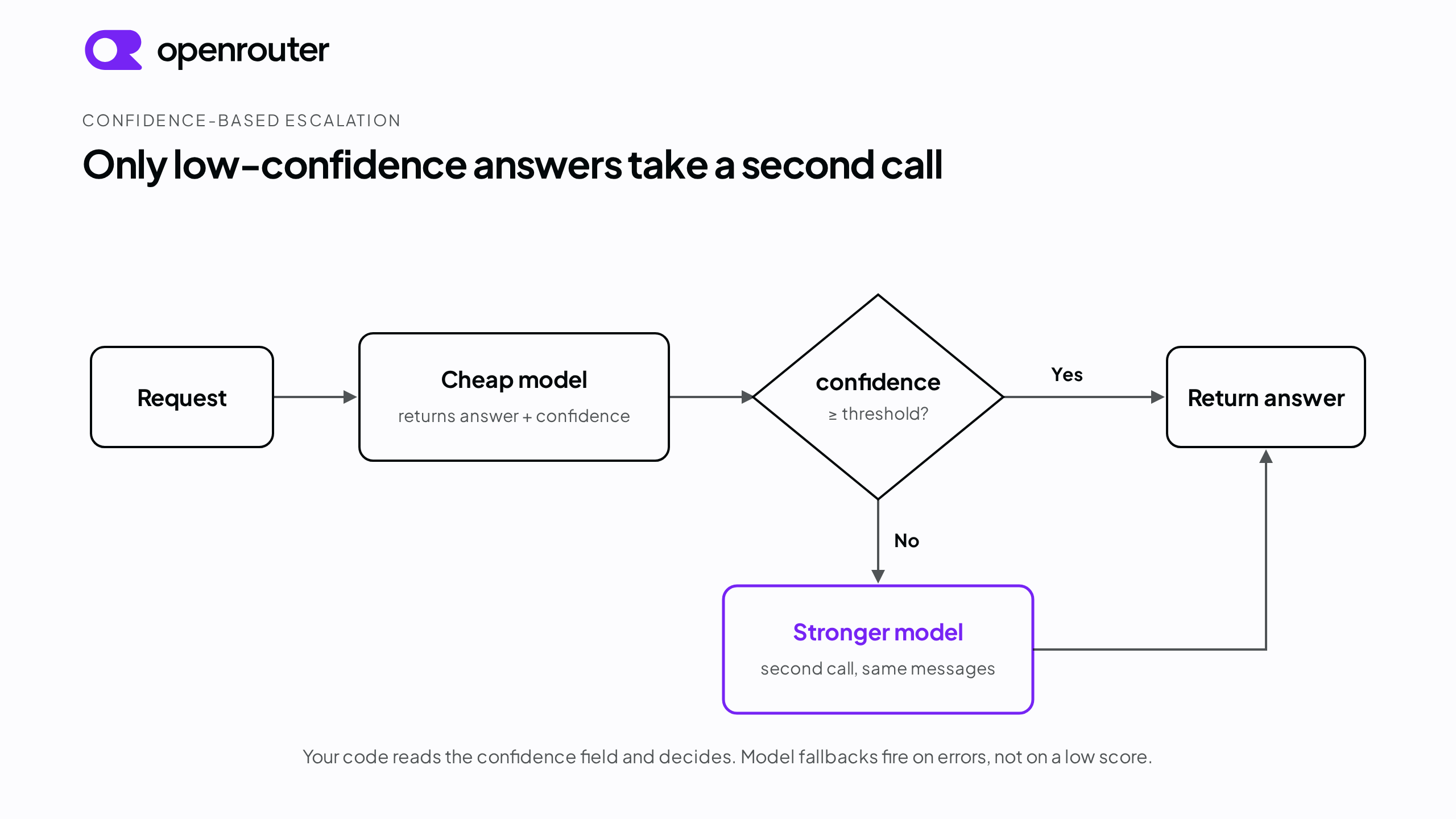
Defining Confidence Scores in LLM Escalation Routing
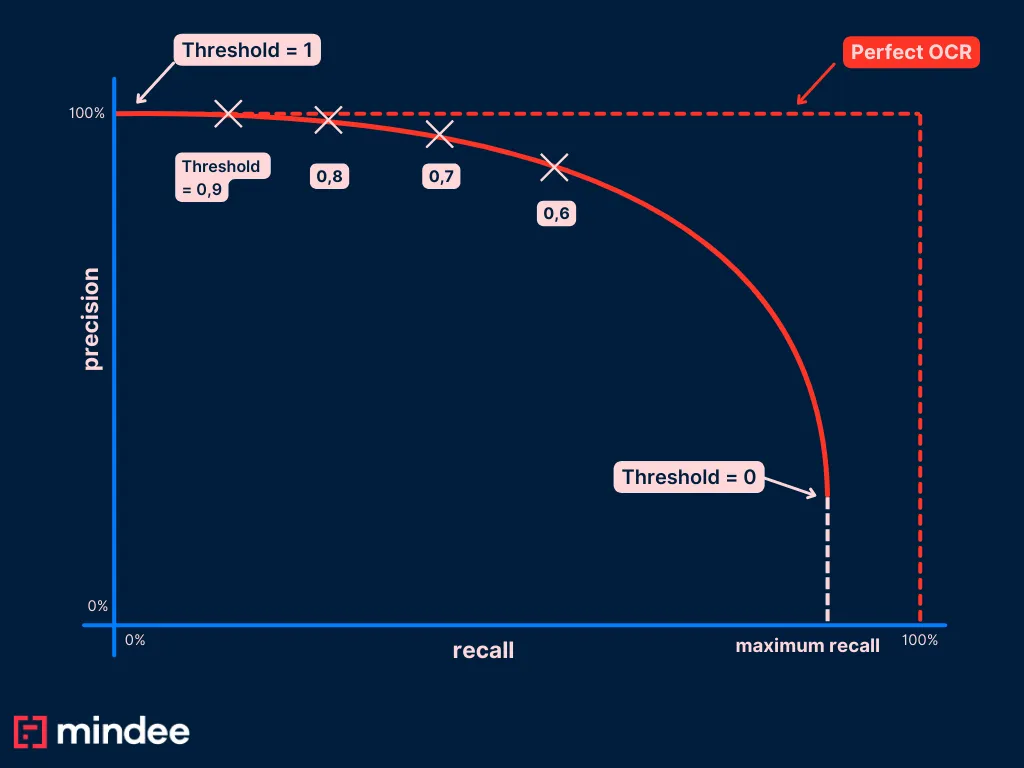
The naive definition of confidence is "the probability the model assigned to its own answer." That is rarely sufficient. In practice you are assembling a signal from several sources, each with different failure modes.
Token logprobs are the cheapest signal. If your provider returns per-token log probabilities, you can convert them into a sequence-level score using a length-normalized geometric mean:
import math

def sequence_confidence(token_logprobs: list[float]) -> float:
    """Geometric mean of per-token probabilities, in [0, 1]."""
    if not token_logprobs:
        return 0.0
    mean_logprob = sum(token_logprobs) / len(token_logprobs)
    return math.exp(mean_logprob)
The catch is that raw logprobs are poorly calibrated. The result may look like 0.93 while the model is actually correct only 70% of the time on that class of input — a gap documented extensively since Guo et al.'s 2017 work on calibration of modern neural networks. Logprobs also are not comparable across providers: tokenizers differ, so the same sentence produces different token counts and different average logprobs depending on who served it.
Self-consistency (Wang et al., 2022) samples the same prompt several times and measures agreement. Semantic entropy (Kuhn et al., 2023) goes further by clustering meaning-equivalent answers before computing entropy, which matters when the model paraphrases the same correct answer five different ways. Retrieval grounding checks whether claims in the output are actually supported by retrieved context — a citation-overlap score is a strong confidence proxy for RAG pipelines. LLM-as-judge scores add a final layer when the task is subjective.
The critical design principle: route on uncertainty combined with business risk, not on raw probability. A 0.7 confidence answer about restaurant recommendations and a 0.7 confidence answer about a medication interaction should not take the same path.
Mapping Escalation Tiers Across Model Providers

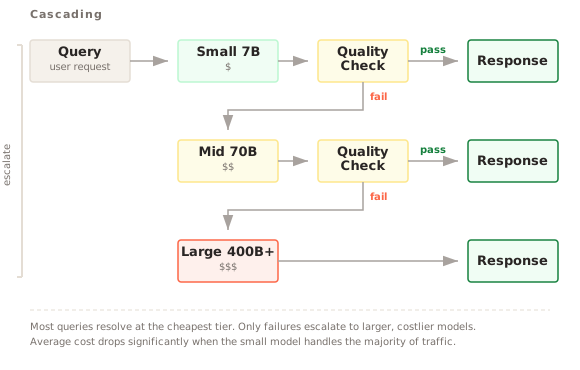
Most mature systems settle into three or four tiers:
| Tier | Typical role | Cost profile | Escalation trigger |
|---|---|---|---|
| Tier 0 | Classification, extraction, FAQ | Lowest | Confidence < 0.60 |
| Tier 1 | Drafting, summarization, routine code | Low | Confidence < 0.72 |
| Tier 2 | Reasoning-heavy or ambiguous tasks | Medium | Confidence < 0.85 |
| Tier 3 | Frontier model or human review | Highest | Confidence < 0.90 or policy match |
The operational headache is that each tier may live on a different provider with a different API shape, different metadata, and different failure semantics. This is where a unified gateway earns its keep. CCAPI is a multimodal AI API gateway that normalizes access to OpenAI, Anthropic, and Google models behind one integration path — so a tier definition is a policy entry, not a new SDK, a new retry strategy, and a new billing relationship. The same gateway exposes image generation APIs and video generation APIs alongside text models, which matters once your escalation logic needs to cover multimodal outputs.
Why Static Fallbacks Are Not Enough
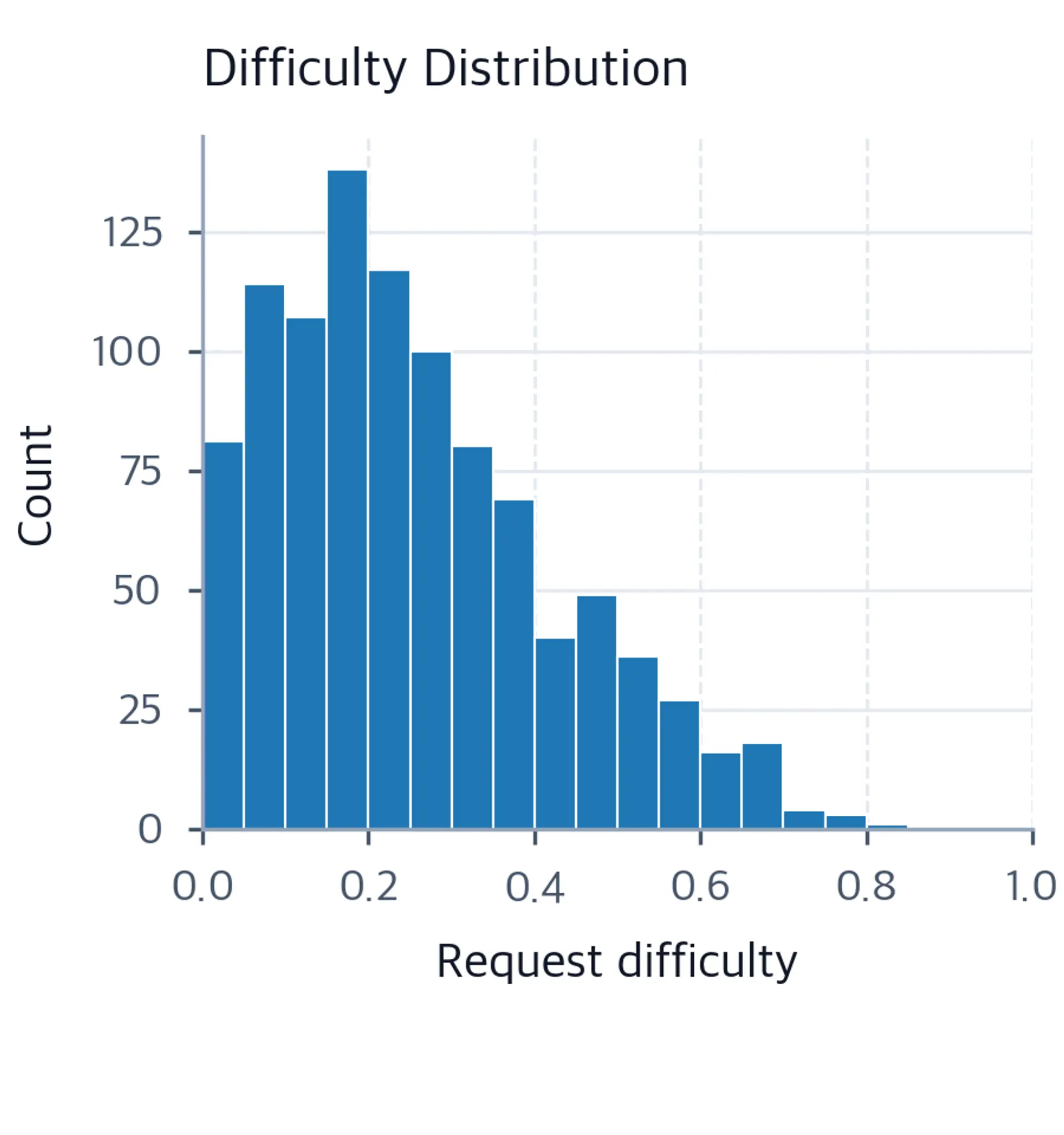
Simple fallback routing looks like this: try the cheap model, and if it errors out or returns malformed JSON, retry on something bigger. That handles failures but not wrong answers. A model can return perfectly valid JSON containing a confidently incorrect number.
The deeper problem is drift. Thresholds are calibrated against a distribution of inputs and a specific model checkpoint. When a provider ships an updated checkpoint, when your prompt template changes, or when the traffic mix shifts after a product launch, the confidence distribution moves. A threshold tuned two quarters ago at 0.72 may now escalate 40% of traffic instead of 12% — quietly tripling your inference bill while nobody changed a line of routing code. Fixed thresholds do not fail loudly; they fail as a cost line item.
Designing Multi-Provider Model Routing with CCAPI
Choosing Models for Cost, Latency, and Accuracy
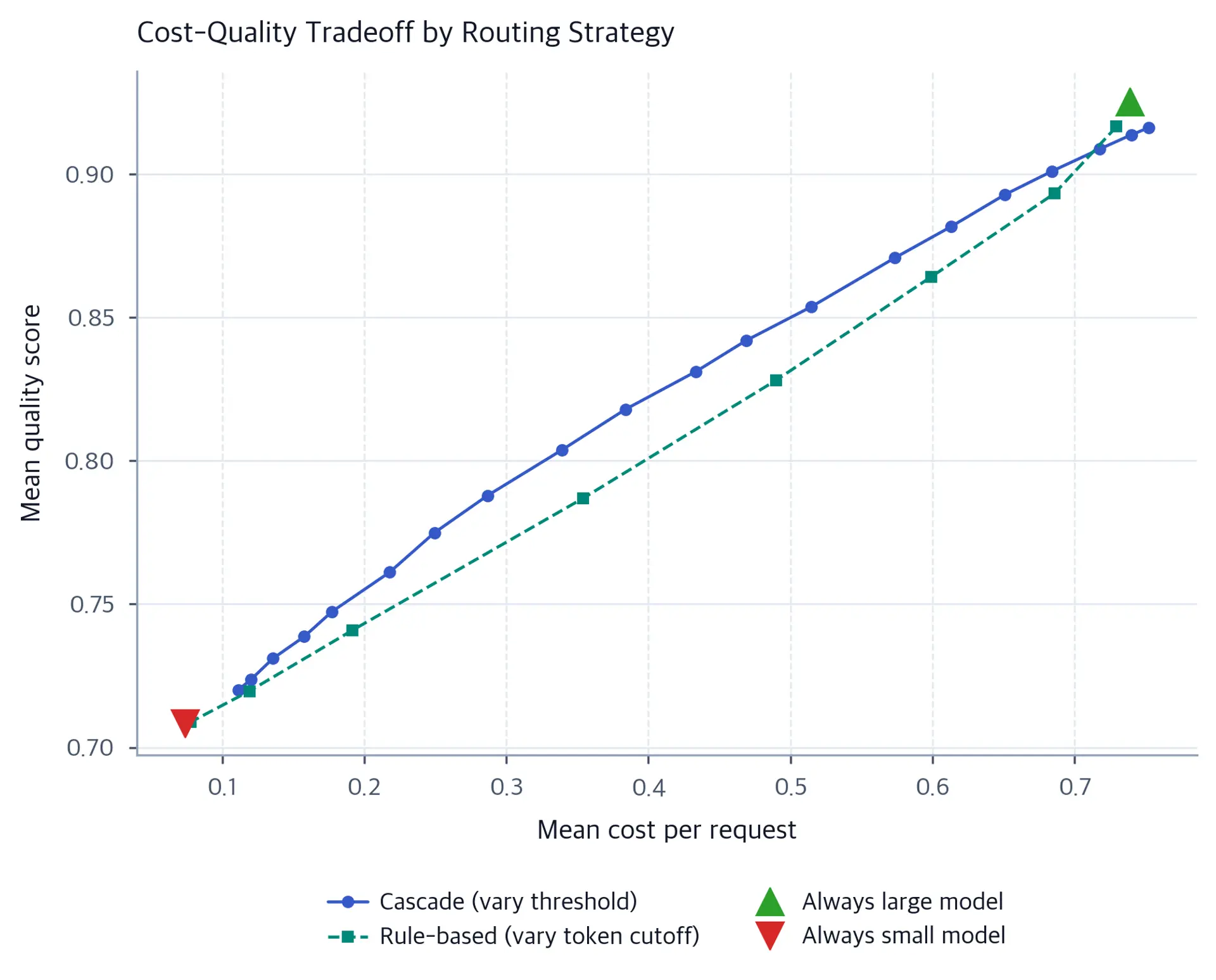
Assign models to tiers by measuring, not by reputation. Pull three numbers per candidate model per workload: median cost per successful task, p95 latency, and accuracy on your own labeled evaluation set. A model that is 30% cheaper but 8 points less accurate on your task may cost more per successful task once you account for escalations and retries it triggers downstream.
A practical tier assignment for a support workload might use a low-cost endpoint such as a DeepSeek API route for FAQ classification, a mid-tier GPT-class model for drafting, and a frontier Claude or Gemini model for policy-sensitive replies. Transparent, per-token pricing across all of them is what makes this calculable — you can see exactly what each escalation decision costs before you commit to a policy, and CCAPI's pricing breakdown lets you model escalation cost as a function of threshold rather than discovering it at invoice time.
Setting Model Fallback Thresholds by Risk Tier
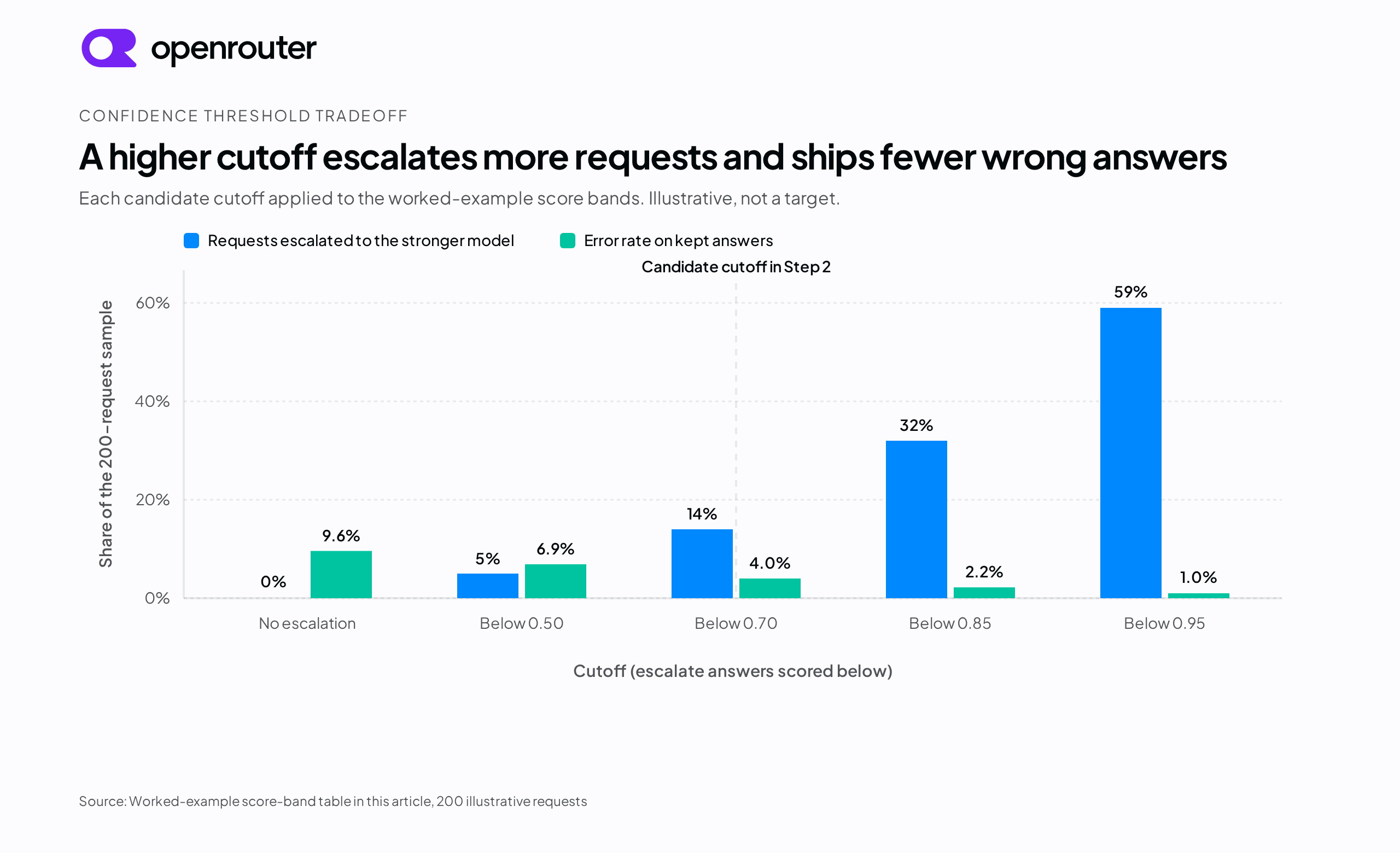
Thresholds should be set per risk tier, not per model. A workable starting policy:
- Low risk (internal summaries, tagging): threshold 0.60, escalate once, no human review.
- Medium risk (customer-facing drafts): threshold 0.75, escalate once, log all escalations.
- High risk (billing, legal, medical, security): threshold 0.88, escalate to frontier, and fall through to human review below 0.65.
Two mechanisms prevent escalation flapping — the pathological case where a query sits near the threshold and bounces between providers across retries:
Hysteresis creates a band. Escalate below 0.75, but only de-escalate below 0.70 on subsequent turns, so small noise does not flip the route.
Cooldown and sticky routing pin a conversation to the escalated tier for a window (often 15–30 minutes) once it has escalated. Without stickiness, a multi-turn support conversation can oscillate between a small model and a frontier model on every message, producing inconsistent tone and unpredictable latency.
Building Unified AI API Routing Logic
Portable routing requires a canonical response envelope. Normalize provider-specific fields — finish reason, token usage, whether logprobs are available at all, safety flags, tool-call structure — into one internal schema before the policy engine sees them. Not every provider exposes token logprobs, so your policy must degrade gracefully to self-consistency or judge scores when the primary signal is missing.
The payoff of centralizing this in a gateway is that routing policy becomes provider-agnostic. Swapping the model behind tier 2 is a configuration change, not a refactor. For teams currently using an OpenRouter alternative purely for model access, the missing piece is usually exactly this: a policy engine that expresses escalation rules declaratively and enforces them consistently across providers, with zero vendor lock-in at the routing layer.
Calibrating Confidence Thresholds for Reliable LLM Escalation Routing
Offline Calibration with Labeled Evaluation Sets
Never ship a threshold you have not calibrated. Build a labeled set of 300–1,000 representative requests per workload and compute three things:
Expected Calibration Error (ECE) buckets predictions by confidence and measures the average gap between predicted confidence and observed accuracy. Brier score gives you a proper scoring rule that penalizes both overconfidence and underconfidence. Reliability diagrams visualize where the model is systematically miscalibrated — usually overconfident in the 0.8–0.95 band, which is precisely where your high-risk threshold lives.
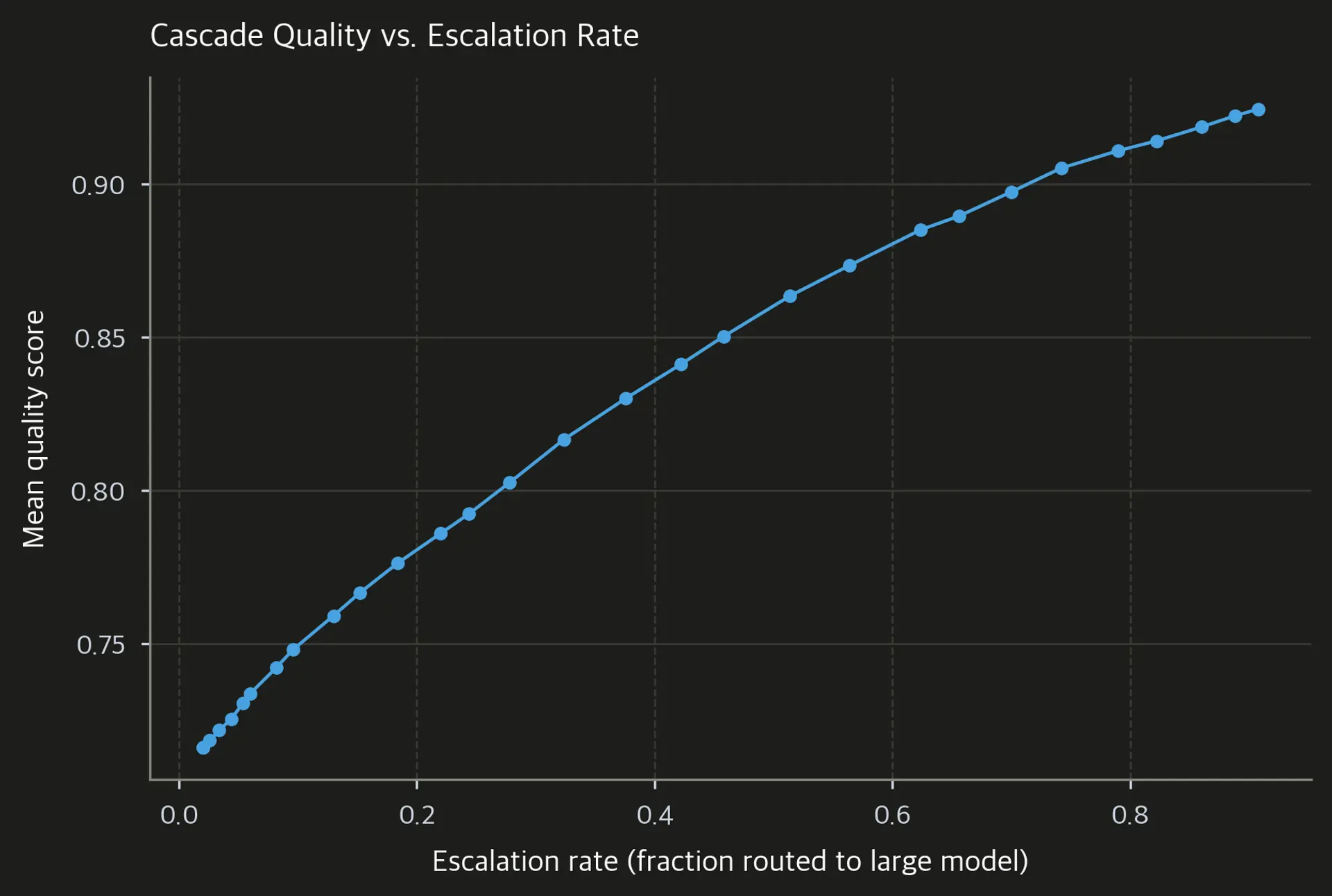
Then choose thresholds by precision/recall tradeoff per use case. For a billing workflow, you may accept a 35% escalation rate to reach 0.98 precision on auto-answered tickets. For internal tagging, 0.85 precision at a 4% escalation rate is fine. Temperature scaling on the confidence score — not the model's sampling temperature — is the standard first fix when a reliability diagram shows a consistent slope error.
Online Calibration and Drift Detection
Offline calibration decays. Monitor the distribution of confidence scores in production and alert on population stability index or Kolmogorov–Smirnov drift against the calibration baseline. Track escalation rate as a first-class SLI: a jump from 12% to 25% week-over-week is a signal, even if accuracy looks unchanged.
Shadow routing is the safest way to evaluate a proposed threshold. Send every request through the current policy for the actual response, and simultaneously compute what the candidate policy would have done — logging the would-be route, cost, and (where labels arrive later) correctness. You get a full counterfactual dataset with zero user-visible risk. In practice, shadow routing for two weeks catches more threshold bugs than any amount of offline analysis.
Composite Confidence Signals Beyond Logprobs
Composite confidence consistently outperforms any single signal, and the reason is that the failure modes are uncorrelated. Logprobs are confident when a model is fluent but wrong. Retrieval checks catch unsupported claims that logprobs miss. Judge models catch instruction violations that retrieval cannot see.
def composite_confidence(signals: dict[str, float], weights: dict[str, float]) -> float:
    total = sum(weights.values())
    return sum(signals[k] * weights.get(k, 0.0) for k in signals) / total
Typical weights for a RAG workload: logprobs 0.25, self-consistency 0.30, retrieval grounding 0.30, judge 0.15. Re-fit those weights during calibration rather than inheriting them — the optimal mix is workload-specific, and grounding-heavy pipelines usually deserve more weight on citation overlap than on token probability.
Implementing Confidence Threshold Model Routing in Production
Architecture Patterns: Gateway, Orchestrator, and Observability
A production topology has four layers. The gateway terminates client requests and handles auth, rate limits, and tenant identification. The routing orchestrator computes confidence signals and calls the policy engine. The policy engine evaluates thresholds and returns a route decision. The observability layer records every decision with its inputs, so you can replay and audit it.
CCAPI slots in as the provider-access layer beneath the orchestrator, centralizing credentials, logging, and cost tracking so you are not reconciling five billing dashboards. It also handles the unglamorous parts — retries, provider failover, and consistent error shapes — that otherwise leak into your routing code.
Policy-as-Code for Escalation Decisions
Express thresholds as versioned configuration, not as constants buried in application code:
version: 7
tenant: acme-support
defaults:
  cooldown_seconds: 900
  hysteresis: 0.05
routes:
  - name: faq
    risk_tier: low
    primary: tier0-fast
    threshold: 0.60
    escalate_to: tier1-balanced
  - name: billing
    risk_tier: medium
    primary: tier1-balanced
    threshold: 0.75
    escalate_to: tier2-frontier
  - name: legal
    risk_tier: high
    primary: tier2-frontier
    threshold: 0.88
    escalate_to: human_review
Every threshold change should carry an author, a justification, and an evaluation result attached to the commit. When an incident review asks "why did billing queries start escalating to the frontier model on March 3rd," the answer should be a diff, not an archaeology project.
Testing and Canarying Thresholds Safely
Run A/B tests on policies, not just prompts. Guardrail metrics should include escalation rate, cost per successful task, p95 latency, and a correctness proxy from human review sampling. Interleaved experiments — where requests are randomly assigned within the same session cohort — control for traffic-mix confounds better than simple time-sliced A/B tests.
Always define the rollback before the rollout. A single configuration flip should restore the previous policy version, and that flip should be testable in staging against recorded production traffic.
Real-World Examples of LLM Escalation Routing
Customer Support Triage: Low-Confidence Escalation to Frontier Models
A support bot handles order status and FAQ with a small model, and routes billing disputes, legal language, and detected frustration to a frontier model. Frustration detection is a cheap classifier that acts as a risk multiplier: even at 0.85 model confidence, an angry customer on a billing issue escalates. The measurable outcome is a reduction in hallucinated policy statements, because the tier that answers billing questions is the tier that was evaluated on billing questions.
Code Generation and Review: Multi-Provider Model Routing for Accuracy
A coding assistant drafts with a fast model and escalates when the diff touches authentication, cryptography, or dependency manifests. Escalation here is triggered by a policy match rather than confidence — a deliberately conservative rule, since a confidently wrong security fix is worse than a slow correct one. Tool-based validation strengthens the signal: if the generated patch fails the project's test suite or a linter, that failure is treated as confidence zero regardless of logprobs. Teams running agentic coding workflows often wire this validation through an MCP server, which gives the routing orchestrator a structured way to call tools and feed results back into the escalation decision.
Regulated Workflows: Human-in-the-Loop Fallback Thresholds
In regulated domains, the terminal escalation tier is a human, not a bigger model. Conservative thresholds (0.88+) combined with mandatory audit trails mean every auto-answered request carries a traceable confidence score, the signals that produced it, the model version, and the policy version. If a regulator asks how a decision was made, the answer is a query against the decision log.
Common Pitfalls in Model Fallback Thresholds and Multi-Provider Model Routing
Overfitting thresholds to one provider. Calibration differences between providers are real and can be large. A threshold tuned on one provider's logprobs may be meaningless on another's — or unusable if that provider does not expose logprobs. Normalize through a unified AI API routing layer and calibrate per provider, then compare.
Ignoring cost and latency feedback loops. Escalation storms are self-reinforcing: a provider slowdown raises latency, which raises timeouts, which raises escalation rate, which raises cost. Cap escalation rate per tenant per minute and treat the cap as a circuit breaker. Cost-aware thresholds — where the policy explicitly declines to escalate when the expected value of the better answer is lower than the marginal cost — prevent budget blowouts.
Treating confidence as ground truth. High confidence can still be wrong, especially on out-of-distribution inputs. Keep a validation layer: retrieval checks, schema validation, policy constraints, and periodic human sampling. Confidence is a routing signal, not a correctness guarantee.
Performance Benchmarks and Tradeoffs for Unified AI API Routing
Track four numbers per policy version:
| Metric | What it tells you |
|---|---|
| Escalation rate | How often you pay for the expensive tier |
| Cost per successful task | True unit economics including escalations and retries |
| p95 latency | Worst-case user experience under the policy |
| Human-review rate | Terminal escalation load on operations |
Plot these against each other to find the knee of the curve — the point where lowering thresholds further buys negligible accuracy for significant cost. Most teams find it earlier than they expect.
Confidence threshold model routing is a strong fit for variable-difficulty tasks, regulated outputs, and cost-sensitive applications. It is a poor fit for deterministic tasks with exact answers, hard real-time systems where escalation latency is unacceptable, and workflows with no reliable confidence signal at all — in those cases, route statically and invest elsewhere.
The unified gateway approach carries tradeoffs worth naming: an abstraction layer adds a small amount of latency and can hide provider-specific tuning knobs. The benefits — one API for major providers, transparent pricing, zero vendor lock-in, and portable multi-provider model routing — usually dominate once you are managing more than two providers.
Operational Readiness Checklist for Confidence Threshold Model Routing
Metrics, alerts, and dashboards. Dashboard confidence distributions per route, escalation reasons, current thresholds, provider latency, and cost per route. Alert on confidence drift, escalation-rate spikes beyond a defined band, and provider outages. Every escalation should record why it happened — which signal crossed which threshold.
Governance and documentation. Assign a named owner per threshold. Set a review cadence (monthly for high-risk routes). Require approval and an attached evaluation for any threshold change. Document model versions and evaluation results alongside the policy.
Scaling across teams. Central platform teams define baseline policies and safe override ranges; product teams tune thresholds within those bounds. Cost allocation per tenant and per route — visible through CCAPI's token and usage console — turns routing into a measurable, budgetable line item rather than a mystery.
Conclusion
Confidence threshold model routing is less about picking a number and more about building a feedback system around that number. The teams that get it right do three things consistently: they calibrate against their own labeled data rather than trusting raw logprobs, they treat thresholds as versioned policy with owners and audits, and they monitor escalation rate as a first-class metric alongside accuracy and latency. Composite confidence signals, hysteresis, cooldowns, and shadow routing are the practical instruments that keep the system stable as models, prompts, and traffic evolve. Start with one workload, one labeled evaluation set, and one conservative threshold — then let production data tell you where the curve actually bends.