
Batch API: half-price inference by bundling requests
Batch API Inference: A Deep Dive into Half-Price AI Workloads
Every team shipping AI features eventually hits the same wall: the per-token bill grows faster than the product. Batch API inference is the most reliable lever most teams have to cut that bill roughly in half — provided they can tolerate asynchronous results. This deep dive covers how batch inference actually works under the hood, when it pays off, how to build a production-grade batching pipeline, and which failure modes only appear after you've pushed millions of requests through it. We'll also look at how a gateway such as CCAPI's unified multimodal AI API gateway changes the integration economics, especially when a single workflow mixes text, image, and video models.
Understanding Batch API Inference and the Half-Price Advantage
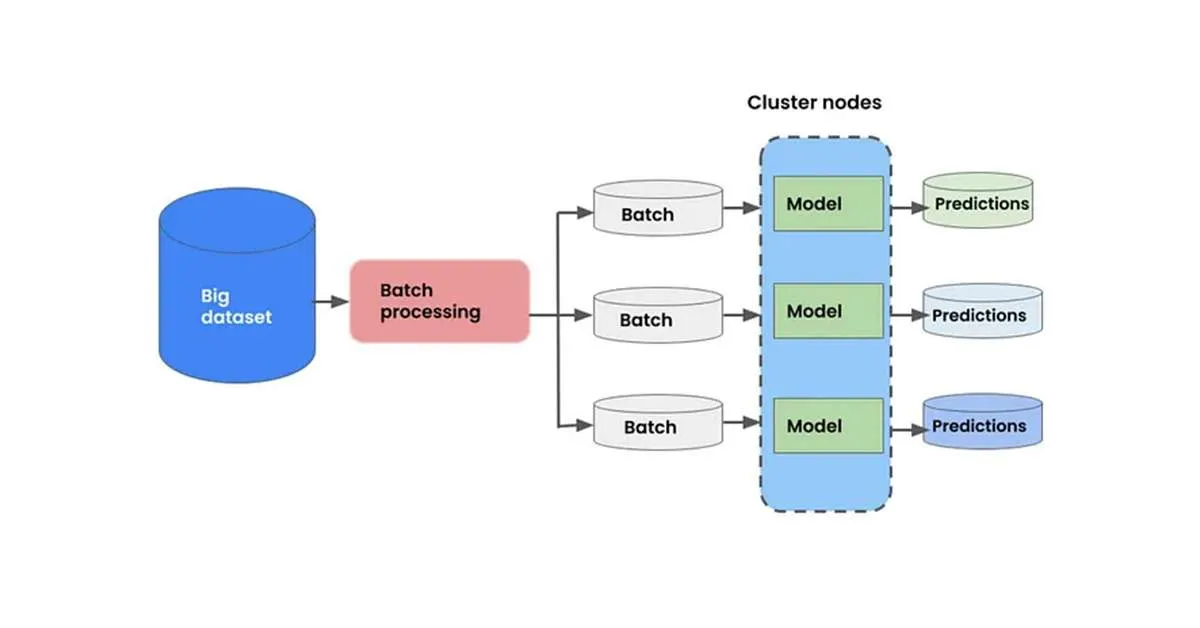
Batch API inference is the practice of submitting many independent model requests as a single asynchronous job, then retrieving the outputs later. Instead of one HTTP round trip per prompt, you upload a file of requests, receive a job identifier, and poll (or wait for a webhook) until the provider finishes processing. Because the provider decides when to run your work rather than running it the instant you ask, it can schedule your tokens into otherwise-idle capacity — and it passes a large share of that efficiency back to you as a discount, typically around 50%.
That single architectural choice cascades into everything else: pricing, latency, error handling, and how you design retries.
What Makes Batch API Inference Different from Real-Time Calls
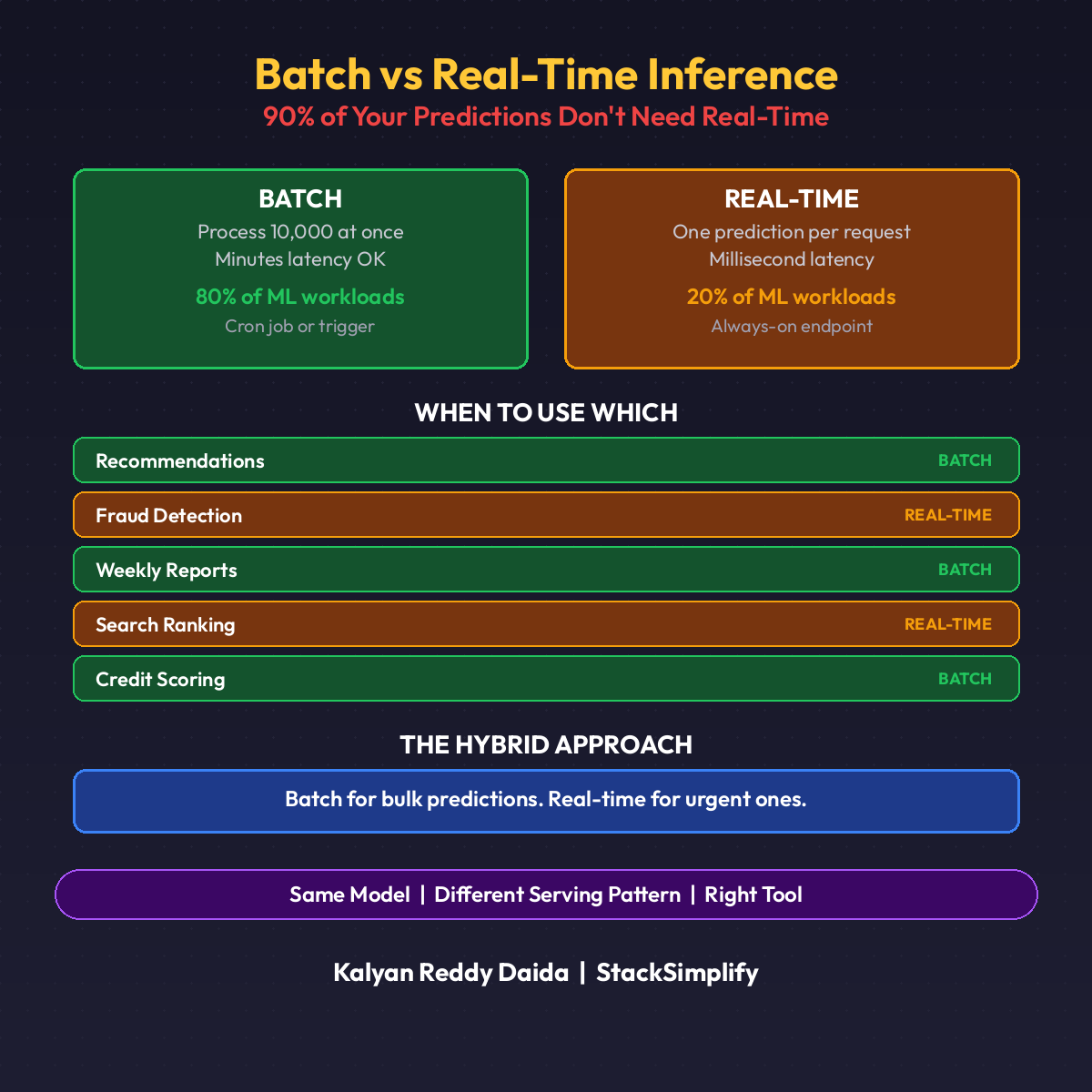
Synchronous endpoints are conversational. You send a request, the connection stays open, and a response comes back in hundreds of milliseconds. The provider must hold capacity warm for you, because it has promised low latency.
Asynchronous batch jobs invert that contract. You submit, you get a job handle, and you poll for status. The provider now has the freedom to pack your requests into large GPU runs alongside other customers' workloads. In practice, this means three new primitives you must design around: job submission, status polling, and result retrieval. There is no in-band response, so your application needs a persistence layer — a database row, a queue message, or a blob path — to reconnect a job ID to the business object it belongs to.
How Batch Queuing Works Under the Hood
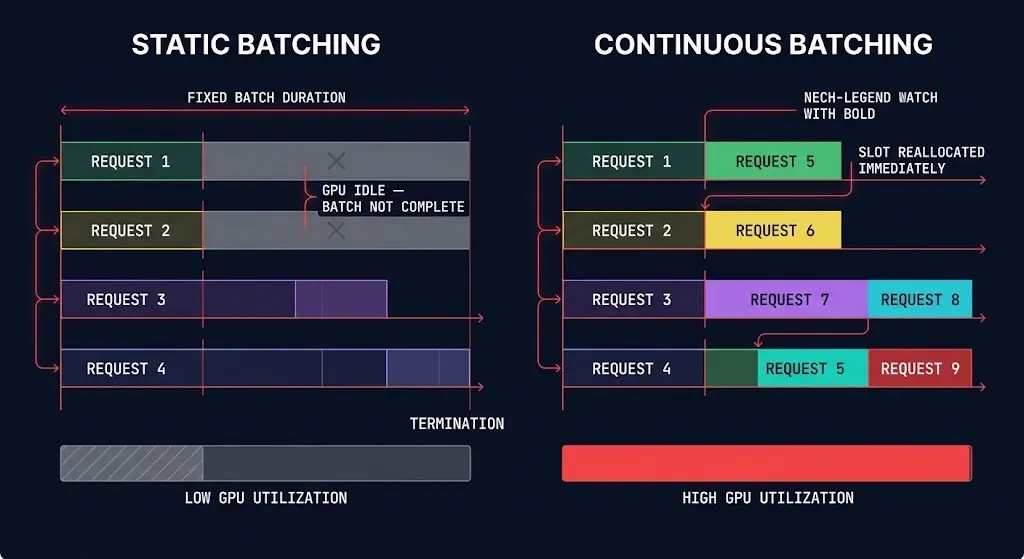
Providers don't process your file immediately. Requests are validated, deduplicated internally in some cases, grouped by model and token profile, and placed into a scheduler queue. The scheduler looks for opportunities to fill a hardware allocation — for example, an inference node already loaded with a model that has spare throughput before its next high-priority real-time slot.
Token accounting still happens per request. The discount applies to the price per input and output token, not to the number of HTTP calls. This matters: a batch of 10,000 short prompts costs the same in discounted token terms as one giant prompt, so batching never changes your token math — only your rate.
Why Providers Offer Discounted AI API Pricing for Batched Workloads
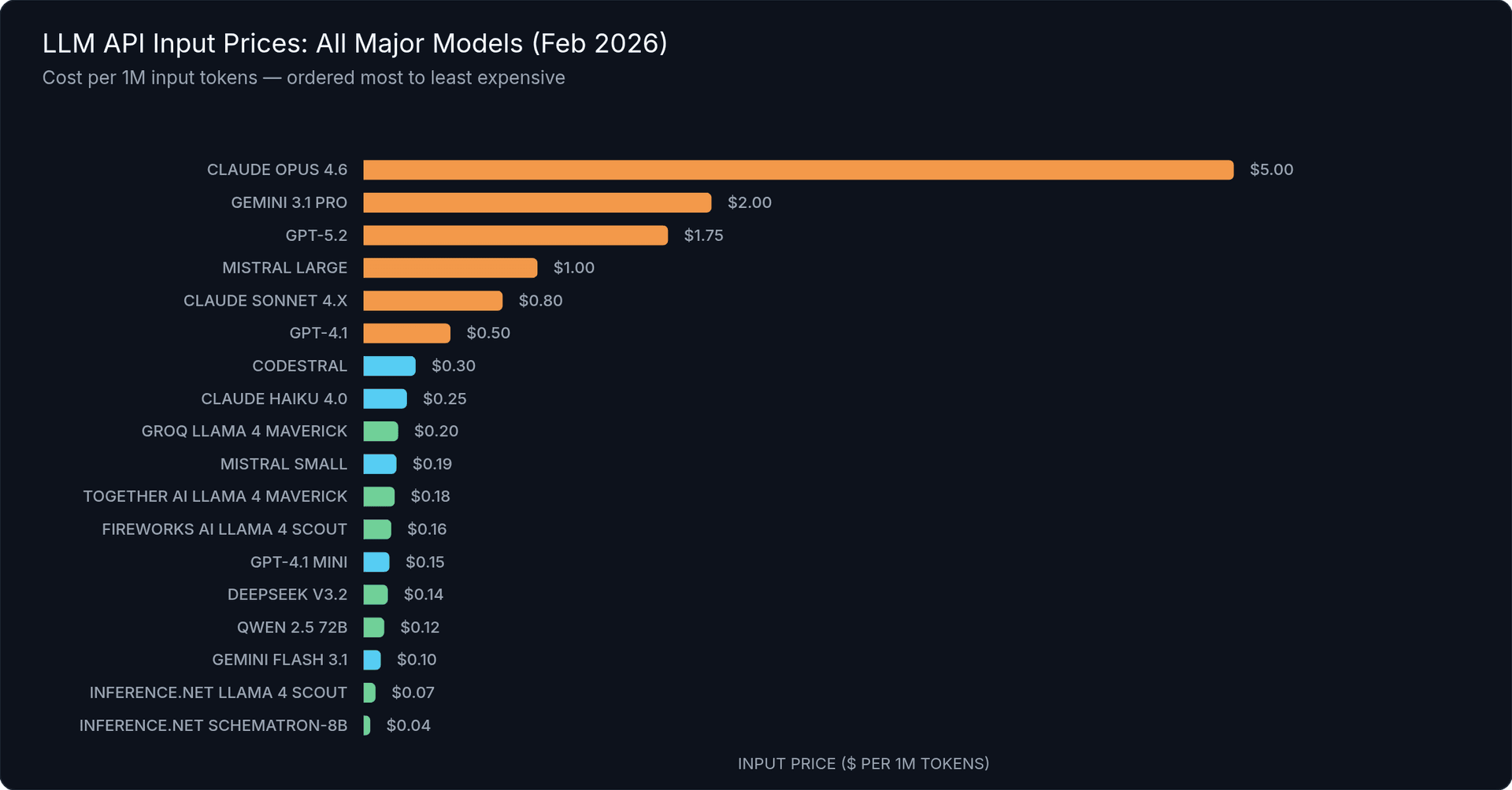
The economics are straightforward. Real-time serving must provision for peak demand, which is expensive and leaves capacity idle during troughs. Batch traffic fills those troughs with work that has no deadline, improving GPU utilization and smoothing load curves. Providers also gain predictability: a queue of committed work is easier to plan capacity around than a burst of unpredictable spikes.
Discounts of 50% are therefore not marketing generosity — they're a fair split of a real efficiency gain. Some providers go further for specific models, and others cap how much discounted volume you can consume per day.
The Core Trade-Off: Cost-Efficient LLM Inference vs. Latency
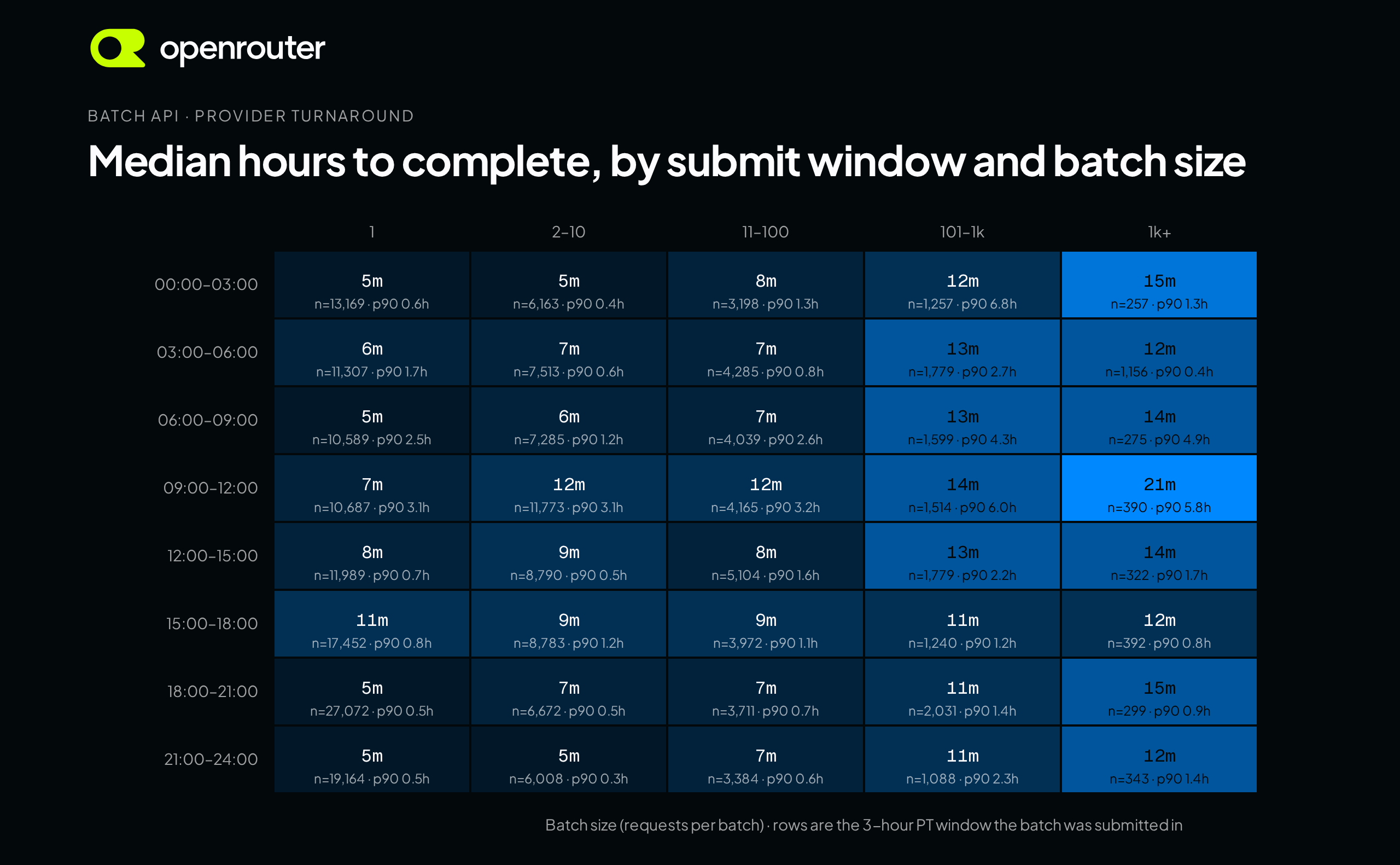
The trade-off is explicit and non-negotiable: batch discounts buy cost efficiency with latency. Turnaround windows are commonly measured in hours, not seconds, and worst-case completion can stretch longer under heavy load. Any workflow where a human is waiting on the result — a chat reply, an autocomplete, an interactive agent — cannot tolerate that. The decision is never "is batch better" but "does this specific workload have a deadline that batch can meet."
When to Use Batch API Inference (and When Not To)
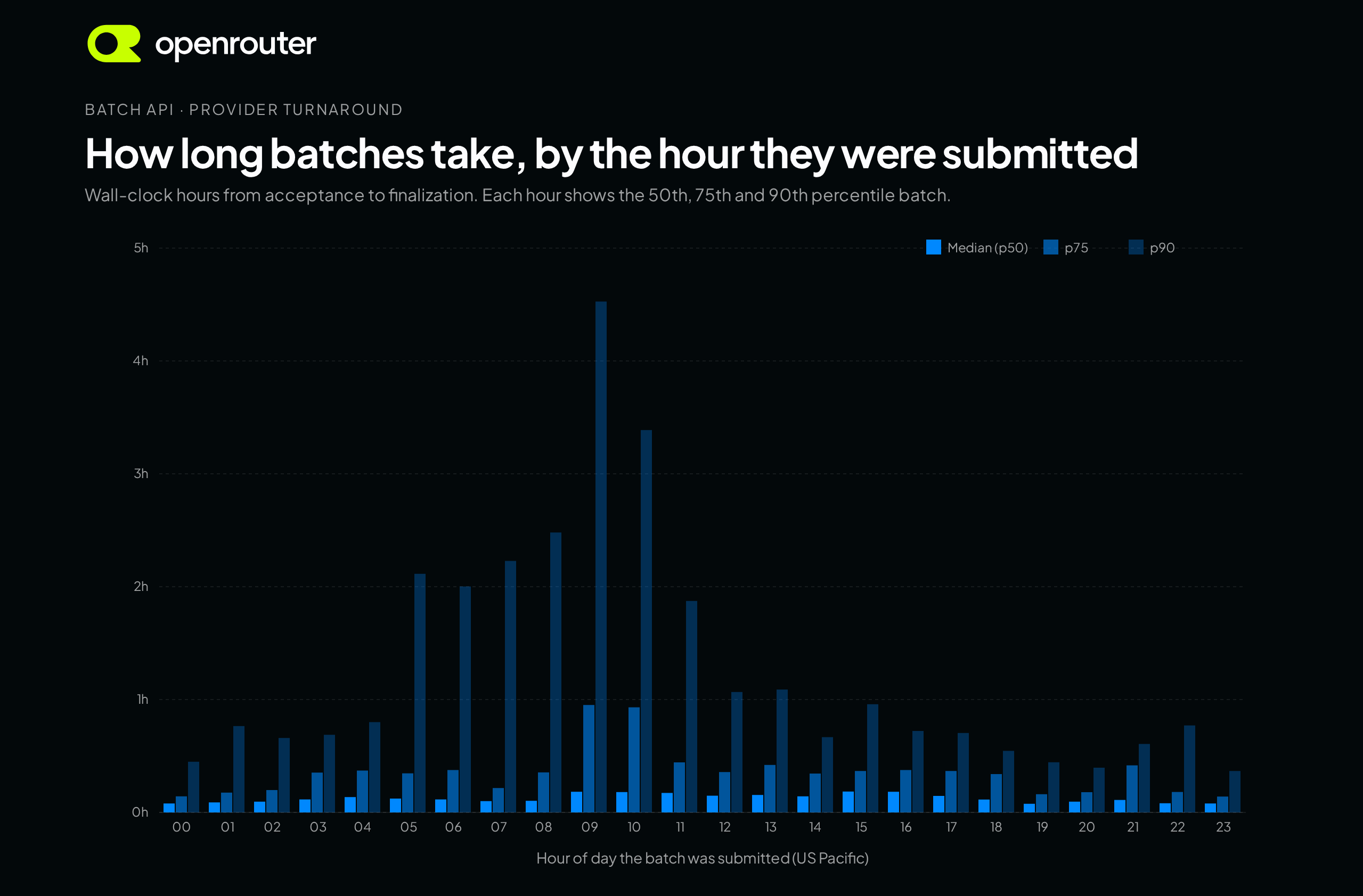
A useful heuristic: if nobody will notice the answer arriving four hours later, batch it. If a user is staring at a spinner, don't.
High-Volume, Non-Urgent Workloads That Benefit from Batch Processing AI API
The classic candidates are backlogs. Content moderation queues where flagged items are reviewed by humans anyway. Overnight document summarization over thousands of PDFs. Bulk translation of a product catalog. Dataset enrichment and labeling for a fine-tuning run. Embedding generation for a retrieval index rebuild. In each case, the work is large, the deadline is measured in hours, and the cost delta is material enough to justify an engineering investment.
Real-Time, Interactive, or Latency-Sensitive Use Cases
Chatbots, live voice agents, interactive search, IDE copilots, and customer-facing assistants all need sub-second responses. So do agent loops, where one model call feeds the next and latency compounds multiplicatively. A common mistake is batching the outer loop of an agent because token volume looks high — but the agent's own control flow depends on each response, so it degenerates into a serial batch of one, which is the worst of both worlds.
Decision Framework: Bundle AI Requests or Call Live Endpoints?
| Dimension | Real-Time Endpoint | Batch API Inference |
|---|---|---|
| Latency | 100 ms – 3 s | Minutes to 24 h |
| Cost per token | Full price | ~50% (varies by provider/model) |
| Throughput ceiling | Rate-limited per minute | Rate-limited per job/file |
| Failure handling | Retry the request | Retry failed lines within the job |
| Best for | Interactive UX, agents | Backlogs, enrichment, bulk generation |
If your answer to "can this wait until tomorrow?" is yes, batch wins. If it's no, stop optimizing and pay full price. CCAPI's zero vendor lock-in makes this a routing decision rather than an architectural one — the same request shape can go to a live endpoint or a batch queue depending on priority.
How to Bundle AI Requests: Step-by-Step Batch Processing Workflow
Step 1: Inventory and Group Compatible Requests
Cluster prompts by model, modality, token range, and priority. Grouping similar-length prompts is not cosmetic — providers bill and schedule by token profile, and wildly heterogeneous batches can be rejected or split. Keep a separate batch for each model family, and never mix an image generation API call with a text completion call in the same file unless the provider explicitly supports multimodal job types.
Step 2: Choose Request Format and Provider Schema
Most providers converge on JSONL: one JSON object per line, each with a unique custom_id you control. Provider schemas differ in field names and nesting, which is where gateway abstraction earns its keep.
{"custom_id": "doc-001", "method": "POST", "url": "/v1/chat/completions", "body": {"model": "gpt-4o-mini", "messages": [{"role": "user", "content": "Summarize this contract..."}]}}
{"custom_id": "doc-002", "method": "POST", "url": "/v1/chat/completions", "body": {"model": "gpt-4o-mini", "messages": [{"role": "user", "content": "Summarize this invoice..."}]}}
Step 3: Authenticate and Configure Batch Endpoints
You'll need an API key, a project or organization ID, and sometimes a region. Store keys in a secrets manager rather than environment files on shared hosts. On a unified gateway you generate one credential and map it to multiple upstream providers — worth doing once, in a single place, rather than per provider.
Step 4: Submit, Monitor, and Retrieve Results
Submission returns a batch ID. Poll at a sane interval — 30 to 60 seconds early on, backing off to several minutes for long jobs — or register a webhook if the provider supports one.
import time, requests

job = requests.post(
    "https://api.example.com/v1/batches",
    headers={"Authorization": f"Bearer {API_KEY}"},
    json={"input_file_id": file_id, "endpoint": "/v1/chat/completions",
          "completion_window": "24h"},
).json()

while True:
    status = requests.get(f"https://api.example.com/v1/batches/{job['id']}",
                          headers={"Authorization": f"Bearer {API_KEY}"}).json()
    if status["status"] in ("completed", "failed", "expired"):
        break
    time.sleep(30)
Step 5: Handle Partial Failures, Retries, and Idempotency
Batch jobs almost never fail all-or-nothing. Expect a success rate in the high 90s with a tail of malformed or rate-limited lines. Always attach an idempotency key derived from your custom_id so a re-submission doesn't double-charge you, and persist which lines succeeded before you retry the rest.
Provider-Specific Batch API Implementations and How CCAPI Unifies Them
OpenAI Batch API: Key Features and Limits
OpenAI's Batch API applies a 50% discount on eligible chat, embedding, and vision models with a completion window measured in hours. Input is a JSONL file uploaded as a file object; output arrives as another file. Limits apply to file size and total requests per batch, and results expire after a retention window, so download them promptly.
Anthropic Message Batches: What to Expect
Anthropic's Message Batches API follows a similar model with published cost savings on batched requests and its own limits on request count and payload size. Operational differences matter more than the headline discount: validation behavior, error granularity, and how partial results are returned all vary.
Google Vertex AI Batch Prediction: Differences That Matter
Vertex AI's batch prediction is more infrastructure-oriented. Inputs and outputs typically live in Cloud Storage buckets, jobs are region-scoped, and pricing nuances depend on the model and machine class. This is powerful for data-engineering-heavy teams and awkward for application developers who just want to post a JSONL file.
What Official Documentation and Industry Experts Recommend
The recurring guidance across provider docs is consistent: keep batches to a manageable size so failures are cheap to rerun, always use idempotency identifiers, download results before retention expires, and validate schemas locally before submitting. Treat completion-window promises as best-effort targets, not SLAs, unless your contract says otherwise.
How CCAPI Simplifies Multi-Provider Batch API Inference
Instead of three SDKs, three auth models, and three result formats, CCAPI's unified multimodal AI API gateway exposes one interface across OpenAI, Anthropic, Google, DeepSeek, Qwen, GLM, Kimi, and MiniMax endpoints, plus image and video generation. You can browse supported models at /models/, mint a key at /console/token, and top up at /console/topup. Teams building agent tooling can also expose batch submission as an MCP server via /mcp. For an openrouter alternative with transparent pricing and zero vendor lock-in, this collapses weeks of integration work into an afternoon.
Cost-Efficient LLM Inference: Budgeting and Discount Optimization
How Batch Discounts Are Calculated Across Providers
Discounts are multipliers on your per-token rate, not flat rebates. If a model costs $2.50 per million input tokens at real time and the batch multiplier is 0.5, batched input costs $1.25 per million. Output tokens are discounted the same way. Some providers exclude certain models, and a few cap total discounted tokens per day.
Break-Even Analysis: Batch vs. Real-Time Pricing
The formula is simple. Let $C_r$ be full-price cost per token and $C_b = d \cdot C_r$ the batched cost. Savings per token are $C_r(1-d)$. Your batching investment is engineering time plus storage, retries, and the cost of delay. Break-even volume is investment divided by savings per token. For a workload of 50 million tokens per month at $3 per million with a 0.5 multiplier, you save $75,000 monthly — enough to justify essentially any reasonable engineering spend.
Hidden Costs: Storage, Retrieval, and Idle Compute
The discount is real; the total cost picture is not just tokens. Result files accumulate storage charges. Failed lines require re-runs at full or partial cost. Data egress from cloud storage can quietly exceed the token savings on small jobs. And polling loops that run in always-on workers burn compute even when no batch is active — use event-driven triggers instead.
Using CCAPI's Transparent Pricing to Forecast Batch Spend
Provider-by-provider invoicing makes forecasting painful when you route across four vendors. A single pricing surface with per-model rates, discount multipliers, and usage history turns budget planning into arithmetic instead of archaeology, which is precisely why CCAPI's transparent pricing and zero vendor lock-in matter for finance teams as much as engineering.
Advanced Techniques for Optimizing Batch API Inference
Request Deduplication and Semantic Caching
Real corpora contain near-duplicates. Hash normalized prompts for exact dedup, and add an embedding-based similarity cache for near-matches above a threshold. On a 5–15% duplicate rate this is directly proportional savings with no quality loss.
Prompt Compression and Token Reduction for Batch Jobs
Batch jobs tolerate slightly higher preprocessing costs because the savings repeat across millions of calls. Strip boilerplate, compress retrieved context, and prefer structured summaries of long documents over raw text. Every input token removed is a token not billed at either the full or discounted rate.
Dynamic Batching and Queue Prioritization
Run at least two lanes: a normal lane for overnight work and an expedited lane for results needed within the hour. Some providers expose service tiers; on a gateway you can route the urgent lane to a real-time endpoint and the rest to batch. Mixing them in one queue means everything inherits the slowest deadline.
Tuning Parallelism Without Hitting Rate Limits
Concurrency isn't free. Provider quotas apply to batch submissions too, and hammering the status endpoint can trigger throttling. Use exponential backoff with jitter on both submission and polling, and cap concurrent jobs per provider rather than per process.
Hidden Insight: Batch Rate Limits and Discount Caps
The detail that bites teams at scale: discounts are frequently capped. Providers may limit discounted tokens per day, restrict which models qualify, or reduce the multiplier for premium models. Budget for your batch traffic spilling into full-price territory once you cross those ceilings — or spread load across multiple providers through one gateway to stay under each cap.
Common Pitfalls in Batch Processing AI API Workflows
Timeout, Expiration, and Job Lifecycle Mistakes
Results expire. Jobs expire. If your pipeline assumes a batch stays queryable indefinitely, you will lose data silently. Persist outputs the moment a job completes and alert if a retention deadline approaches.
Duplicate Processing and Idempotency Gaps
Without idempotency keys, a retry after a network timeout can double-charge you and produce duplicate rows downstream. Derive keys deterministically from business identity, not timestamps.
Provider-Specific Batch Size and Format Limits
Every provider sets its own file size, request count, and token ceilings, and modality constraints differ — you generally cannot mix a text-to-video request and a text completion in the same job. Validate locally before submitting; a rejected 2 GB upload is a slow way to learn a limit.
Poor Observability and Error Handling
Log the batch ID, job status, per-line outcome, and the exact error class. Distinguish retryable errors (rate limits, transient 5xx) from terminal ones (schema failures, policy refusals). Alerting on aggregate failure rate rather than individual failures prevents pager fatigue.
Lessons from Production: What Breaks First
In our experience, the first thing to break is not the model call — it's the mapping layer between custom_id and your database. The second is retention: teams forget to download outputs and lose a night's work. The third is quota math: one large batch saturates a daily discounted-token cap and the rest of the queue silently bills at full price.
Real-World Examples: Batch API Inference in Production
Case Study: Bulk Content Moderation at Half Price
A marketplace routing 400,000 listings per day through moderation had a 6-hour human review SLA downstream. Batching the automated pre-screen into two overnight jobs cut model spend by roughly 48% while still delivering flags hours before reviewers started. The key insight was that the human SLA, not the model, defined the real deadline.
Case Study: Overnight Document Summarization Pipeline
A legal-tech team processed 12,000 PDFs nightly. Each document was chunked, summarized per chunk, then synthesized — a three-stage batch pipeline where each stage's output file fed the next. Total wall time was three to five hours, results were ready before the morning standup, and cost dropped from roughly $4,100 to $2,050 per night.
Case Study: Multimodal Batch Generation with CCAPI
A marketing platform generates campaign assets overnight: copy, hero images, and short voiceovers. Rather than integrating three vendors' batch systems, the team submitted all three job types through CCAPI's unified multimodal AI API gateway, using the same auth and the same custom_id convention across text, image generation API, and audio models. Integration time fell from an estimated three weeks to four days.
Performance Benchmarks and Reliability Considerations
Latency, Throughput, and Success Rate Benchmarks
Realistic expectations from production batch workloads: median turnaround of 20 minutes to 2 hours for mid-sized jobs, tail latency up to the full completion window under load, and success rates between 97% and 99.5% before retries. Retrying the failed tail typically brings effective success above 99.9%. Throughput scales with job size, not concurrency, so a 500,000-request job often finishes in a similar window to a 50,000-request job — which is a strong argument for batching aggressively.
When the 50% Discount Is Not Worth the Delay
Skip batch when the result is on a critical path, when you need fewer than a few thousand requests per day (engineering cost dominates savings), when the model isn't eligible for the discount, or when you're prototyping and iteration speed matters more than unit cost. Also avoid batch for anything with a contractual latency commitment.
Pros and Cons of Batch API Inference for Different Teams
Startups benefit most — cost per unit of work is often existential. Enterprises gain predictability and easier capacity planning. Research teams love batch for large evaluation sweeps. Regulated environments need to check retention windows and data residency before committing, since batch input files often sit in provider storage longer than real-time request logs.
Trust Signals: What to Verify Before Committing
Before standardizing on any batch offering, verify five things: published per-token discount multipliers, a written retention policy for input and output files, model version pinning, support escalation paths, and whether the discount is capped. CCAPI's transparent pricing and multi-provider access make these comparisons a single-page exercise rather than five vendor conversations.
Operational Checklist for Ongoing Batch API Efficiency
Pre-Submission Validation Checklist
- Validate JSONL line-by-line against the provider schema before upload
- Enforce per-request token ceilings and reject oversized prompts locally
- Confirm every request carries a deterministic idempotency key
- Check file size and request count against current provider limits
- Verify model names and versions are pinned, not floating aliases
Monitoring, Cost Tracking, and Alerting Checklist
- Track spend per batch, per model, and per provider daily
- Alert when batch success rate drops below 97%
- Alert when discounted-token caps approach their ceiling
- Monitor median and p95 turnaround against your SLA
- Log every retry with its originating
custom_id
Scaling and Provider Migration Checklist
- Keep request construction decoupled from provider-specific field names
- Version your batch schemas so migrations don't require code rewrites
- Test a canary job against any new provider before full cutover
- Route across providers when one hits quota limits
- Prefer a gateway abstraction — CCAPI's zero vendor lock-in means switching upstream models is a config change, not a refactor
Batch API inference is not a hack or a workaround. It's the natural shape of AI work that has value but no deadline, and it's the single highest-leverage cost decision most teams can make this quarter. Get the job lifecycle, idempotency, and observability right, and half-price inference becomes a boring, reliable part of your infrastructure.